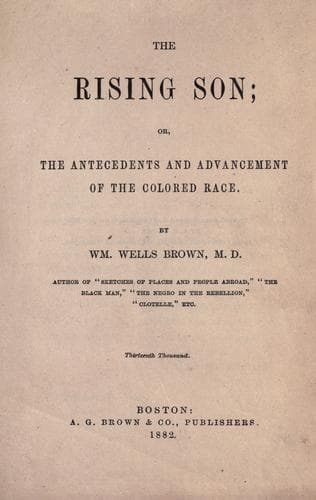
The Rising Son; or, the Antecedents and Advancement of the Colored RaceBrown, William Wells
History
The Rising Son; or, the Antecedents and Advancement of the Colored Race
Brown, William Wells
African Americans -- Biography; African Americans -- History; Black race; Slavery -- United States
The battle of Poison Springs, Arkansas, between one thousand Union and
eight thousand rebel troops, was one of the most severe conflicts of
the war. Six hundred of the Union forces were colored, and from Kansas,
some of them having served under old John Brown during the great
struggle in that territory. These black men, as it will be seen, bore
the brunt of the fight, and never did men show more determined bravery
than was exhibited on this occasion.
Nothing in the history of the Rebellion equalled in inhumanity and
atrocity the horrid butchery at Fort Pillow, Kentucky, on the 13th of
April, 1864. In no other school than slavery could human beings have
been trained to such readiness for cruelties like these. Accustomed
to brutality and bestiality all their lives, it was easy for them to
perpetrate the atrocities which startled the civilized foreign world,
as they awakened the indignation of our own people.
After the rebels were in undisputed possession of the fort, and the
survivors had surrendered, they commenced the indiscriminate butchery
of all the Federal soldiery. The colored soldiers threw down their
guns, and raised their arms, in token of surrender; but not the least
attention was paid to it. They continued to shoot down all they found.
A number of them, finding no quarter was given, ran over the bluff
to the river, and tried to conceal themselves under the bank and in
the bushes, where they were pursued by the rebel savages, whom they
implored to spare their lives. Their appeals were made in vain; and
they were all shot down in cold blood, and, in full sight of the
gunboat, chased and shot down like dogs. In passing up the bank of the
river, fifty dead might be counted strewed along. One had crawled into
a hollow log, and was killed in it; another had got over the bank into
the river, and had got on a board that ran out into the water. He lay
on it on his face, with his feet in the water. He lay there, when
exposed, stark and stiff. Several had tried to hide in crevices made by
the falling bank, and could not be seen without difficulty; but they
were singled out, and killed. From the best information to be had, the
white soldiers were, to a very considerable extent, treated in the same
way.
We now record an account of the battle of Honey Hill, South Carolina,
and one of the most famous engagements in which the blacks fought
during the war.
Public-domain text, read in full here on John Shaqi.
Reviews
Reviews
No reviews yet
Be the first to share your thoughts on this work.
Elsewhere in the archive
Join the Discussion
Join the discussion
Sign in to leave a comment or review.
Sign InorCreate an account