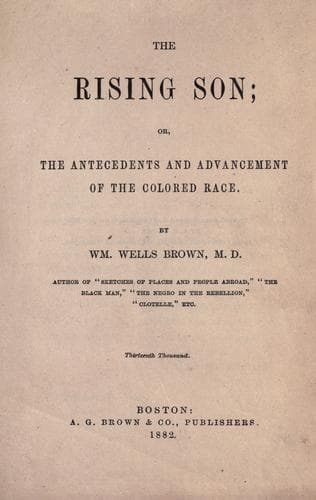
The Rising Son; or, the Antecedents and Advancement of the Colored RaceBrown, William Wells
History
The Rising Son; or, the Antecedents and Advancement of the Colored Race
Brown, William Wells
African Americans -- Biography; African Americans -- History; Black race; Slavery -- United States
This was the first experience of the men under actual fire, and they
behaved finely. When the outer works around Petersburg were attacked,
June 15, Duncan’s brigade met the rebels, and did good service, driving
the enemy before him. We had a number killed and wounded in this
engagement. The rebels sought shelter in their main works, which were
of the most formidable character. These defences had been erected by
the labor of slaves, detailed for the purpose. Our forces followed
them to their stronghold. The white troops occupied the right; and in
order to attract the attention of the enemy, while these troops were
manœuvring for a favorable attacking position, the colored soldiers
were subject to a most galling fire for several hours, losing a number
of officers and men. Towards night, the fight commenced in earnest by
the troops on the right, who quickly cleared their portion of the line;
this was followed by the immediate advance of the colored troops, the
Fourth, Fifth, Sixth, and Twenty-second Regiments. In a very short
time the rebels were driven from the whole line; these regiments
capturing seven pieces of artillery, and a number of prisoners. For
their gallantry in this action the colored troops received a highly
complimentary notice from General W. H. Smith in General Orders.
A few hours after entering the rebel works, our soldiers were gladdened
by a sight of the veterans of the Army of the Potomac, who that
night relieved our men at the front. A glance at the strong works
gave the new-comers a better opinion of the fighting qualities of
the negroes than they had calculated upon; and a good feeling was at
once established, that rapidly dispelled most of the prejudices then
existing against the blacks; and from that time to the close of the
war, the negro soldier stood high with the white troops.
After spending some time at the Bermuda Hundreds, the Sixth Regiment
was ordered to Dutch Gap, Virginia, where, on the 16th of August, they
assisted in driving the rebels from Signal Hill; General Butler, in
person, leading our troops. The Sixth Regiment contributed its share
towards completing Butler’s famous canal, during which time they were
often very much annoyed by the rebel shells thrown amongst them. The
conduct of the men throughout these trying scenes reflected great
credit upon them. On the 29th of September, the regiment occupied the
advance in the demonstration made by Butler that day upon Richmond. The
first line of battle was formed by the Fourth and Sixth Regiments; the
latter entered the fight with three hundred and fifteen men, including
nineteen officers.
Public-domain text, read in full here on John Shaqi.
Reviews
Reviews
No reviews yet
Be the first to share your thoughts on this work.
Elsewhere in the archive
Join the Discussion
Join the discussion
Sign in to leave a comment or review.
Sign InorCreate an account