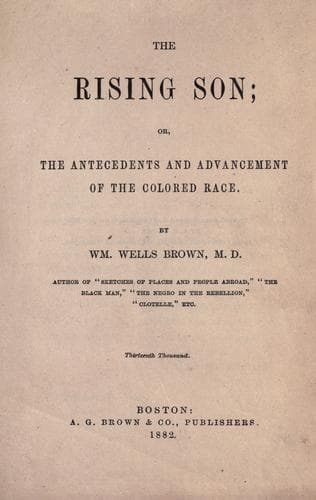
The Rising Son; or, the Antecedents and Advancement of the Colored RaceBrown, William Wells
History
The Rising Son; or, the Antecedents and Advancement of the Colored Race
Brown, William Wells
African Americans -- Biography; African Americans -- History; Black race; Slavery -- United States
The enemy were driven back from within two miles of Deep Bottom, to
their works at New Market Heights; the Sixth was compelled to cross a
small creek, and then an open field. They were met by a fearful fire
from the rebel works; men fell by scores; still the regiment went
forward. The color-bearers, one after another, were killed or wounded,
until the entire color-guard were swept from the field. Two hundred and
nine men, and fourteen officers, were killed and wounded. Few fields of
battle showed greater slaughter than this; and in no conflict did both
officers and men prove themselves more brave. Captains York and Sheldon
and Lieutenant Meyer were killed close to the rebel works. Lieutenants
Pratt, Landon, and McEvoy subsequently died of the wounds received.
Lieutenant Charles Fields, Company A., was killed on the skirmish-line:
this left the company in charge of the first sergeant, Richard Carter,
of Philadelphia, who kept it in its advanced position through the
entire day, commanding with courage and great ability, attracting
marked attention for his officer-like bearing. During the battle many
instances of unsurpassed bravery were shown by the common soldier,
which proved that these heroic men were fighting for the freedom of
their race, and the restoration of a Union that should protect man
in his liberty without regard to color. No regiment did more towards
extinguishing prejudice against the Negro than the patriotic Sixth.
CHAPTER XLVI.
NEGRO HATRED AT THE NORTH.
The prompt manner in which colored men in the North had enlisted in
the army to aid in putting down the Rebellion, and the heroism and
loyalty of the slaves of the South in helping to save the Union, so
exasperated the disloyal people in the Northern States, that they
early began a system of cowardly warfare against the blacks wherever
they found them. The mob spirit first manifested itself at a meeting
held in Boston, December 3, 1860, to observe the anniversary of the
death of John Brown. A combination of North End roughs and Beacon
Street aristocrats took possession of the Tremont Temple, the place of
holding the meeting, appointed Richard S. Fay as Chairman, and passed a
series of resolutions in favor of the slave-holders of the South, and
condemnatory of the abolitionists.
This success induced these enemies of free discussion to attempt to
break up the meeting of the Twenty-eighth Congregational Society at
Music Hall the following Sunday, at which Frederick Douglass was the
speaker. Wendell Phillips addressed the same society at the same place,
on the 19th following, when the mob spirit seemed even more violent
than on any previous occasion. These events were still fresh in the
minds of the haters of negro freedom, when, on the 10th of July, 1863,
the great mob commenced in the city of New York.
Public-domain text, read in full here on John Shaqi.
Reviews
Reviews
No reviews yet
Be the first to share your thoughts on this work.
Elsewhere in the archive
Join the Discussion
Join the discussion
Sign in to leave a comment or review.
Sign InorCreate an account