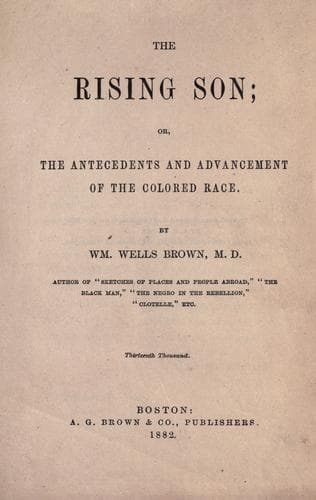
The Rising Son; or, the Antecedents and Advancement of the Colored RaceBrown, William Wells
History
The Rising Son; or, the Antecedents and Advancement of the Colored Race
Brown, William Wells
African Americans -- Biography; African Americans -- History; Black race; Slavery -- United States
The mob was composed of the lowest and most degraded of the foreign
population (mainly Irish), raked from the filthy cellars and dens of
the city, steeped in crimes of the deepest dye, and ready for any
act, no matter how dark; together with the worst type of our native
criminals, whose long service in the prisons of the country, and whose
training in the Democratic party, had so demoralized their natures that
they were ever on the hunt for some deed of robbery or murder.
This conglomerated mass of human beings were under the leadership of
men standing higher than themselves in the estimation of the public,
but, if possible, really lower in moral degradation. Cheered on by men
holding high political positions, and finding little or no opposition,
they went on at a fearful rate.
Never, in the history of mob-violence, was crime carried to such
an extent. Murder, arson, robbery, and cruelty reigned triumphant
throughout the city, day and night, for more than a week.
Hundreds of the blacks, driven from their homes, and hunted and chased
through the streets, presented themselves at the doors of jails,
prisons, police-stations, and begged admission. Thus did these fiends
prowl about the city, committing crime after crime; indeed, in point of
cruelty, the Rebellion was transferred from the South to the North.
The destruction of the colored Orphan Asylum, after first robbing
the little black children of their clothing, seemed a most heartless
transaction.
Nearly forty colored persons were murdered during this reign of terror.
Some were hung at lamp-posts, some thrown off the docks, while others,
shot, clubbed, and cut to pieces with knives, were seen lying dead in
the streets.
Numbers of men and boys amused themselves by cutting pieces of flesh
from the dead body of a black man who was suspended from a lamp-post at
the corner of Prince Street.
Hundreds of colored men and women had taken shelter in the buildings
reached by passing through the “Arch,” on Thompson Street. The mob made
several unsuccessful attempts to gain admission to this alley, where,
in one of the buildings, was a room about thirty by forty feet square,
in the centre of which stood an old-fashioned cook-stove, the top of
which seemed filled with boilers, and all steaming away, completely
filling the place with a dense fog. Two lamps, with dingy chimneys,
and the light from the fire, which shone brightly through the broken
doors of the stove, lighted up the room. Eight athletic black women,
looking for all the world as if they had just returned from a Virginia
corn-field, weary and hungry, stood around the room.
Public-domain text, read in full here on John Shaqi.
Reviews
Reviews
No reviews yet
Be the first to share your thoughts on this work.
Elsewhere in the archive
Join the Discussion
Join the discussion
Sign in to leave a comment or review.
Sign InorCreate an account