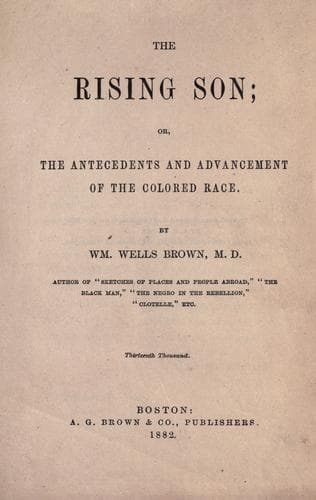
The Rising Son; or, the Antecedents and Advancement of the Colored RaceBrown, William Wells
History
The Rising Son; or, the Antecedents and Advancement of the Colored Race
Brown, William Wells
African Americans -- Biography; African Americans -- History; Black race; Slavery -- United States
Each of these Amazons was armed with a tin dipper, apparently new,
which had no doubt been purchased for the occasion. A woman of
exceedingly large proportions--tall, long-armed, with a deep scar
down the side of her face, and with a half grin, half smile--was the
commander-in-chief of the “hot room.” This woman stood by the stove,
dipper in hand, and occasionally taking the top from the large
wash-boiler, which we learned was filled with boiling water, soap, and
ashes.
In case of an attack, this boiler was to be the “King of Pain.”
Guided by a friend who had furnished us a disguise, the writer entered
the “hot room,” and took a view of its surroundings. As we saw the
perspiration streaming down the faces of these women, we ventured a few
questions.
“Do you expect an attack?” we asked.
“Dunno, honey; but we’s ready ef dey comes,” was the reply from the
aunty near the stove.
“Were you ever in slavery?” we continued.
“Yes; ain’t bin from dar but little while.”
“What State?”
“Bred and born in ole Virginny, down on de Pertomuc.”
“Have you any of your relations in Virginia now?”
“Yes; got six chilens down dar somewhar, an’ two husbuns--all sole to
de speclaturs afore I run away.”
“Did you come off alone?”
“No; my las ole man bring me ’way.”
“You don’t mean to be taken back by the slave-catchers, in peace?”
“No; I’ll die fuss.”
“How will you manage if they attempt to come into this room?”
“We’ll all fling hot water on ’em, an’ scall dar very harts out.”
“Can you all throw water without injuring each other?”
“O yes, honey; we’s bin practicin’ all day.” And here the whole
company joined in a hearty laugh, which made the old building ring.
The intense heat drove us from the room. As we descended the steps and
passed the guards, we remarked to one of them,--
“The women seem to be prepared for battle.”
“Yes,” he replied; “dem wimmens got de debil in ’em to-night, an’ no
mistake. Dey’ll make dat a hot hell in dar fur somebody.”
And here the guards broke forth into a hearty laugh, which was caught
up and joined in by the women in the house, which showed very clearly
that these blacks felt themselves masters of the situation.
As the mob made their last attempt to gain an entrance to the alley,
one of their number, a man bloated with strong drink, and heaping oaths
upon the “niggers,” succeeded in getting through, and made his way to
the “hot room,” where, it is said, he suddenly disappeared. It was
whispered that the washerwomen made soap-grease of his carcass.
The inhabitants of the “Arch” were not again disturbed.
CHAPTER XLVII.
CASTE AND PROGRESS.
Public-domain text, read in full here on John Shaqi.
Reviews
Reviews
No reviews yet
Be the first to share your thoughts on this work.
Elsewhere in the archive
Join the Discussion
Join the discussion
Sign in to leave a comment or review.
Sign InorCreate an account