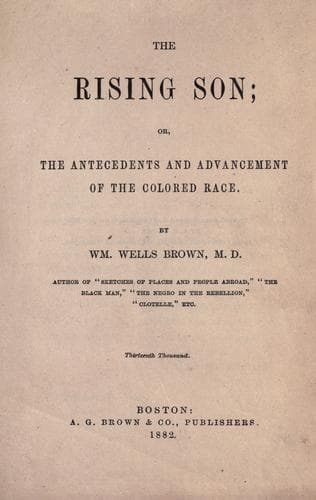
The Rising Son; or, the Antecedents and Advancement of the Colored RaceBrown, William Wells
History
The Rising Son; or, the Antecedents and Advancement of the Colored Race
Brown, William Wells
African Americans -- Biography; African Americans -- History; Black race; Slavery -- United States
Caste is usually found to exist in communities or countries among
majorities, and against minorities. The basis of it is owing to some
supposed inferiority or degradation attached to the hated ones.
However, nothing is more foolish than this prejudice. But the silliest
of all caste is that which is founded on color; for those who entertain
it have not a single logical reason to offer in its defence.
The fact is, slavery has been the cause of all the prejudice against
the negro. Wherever the blacks are ill-treated on account of their
color, it is because of their identity with a race that has long worn
the chain of slavery. Is there anything in black that should be hated?
If so, why do we see so much black in common use as clothing among all
classes? Indeed, black is preferred to either white or colors. How
often the young man speaks in ecstasies of the black eyes and black
hair of his lady-love! Look at the hundreds of advertised hair-dyes,
used for the purpose of changing Nature! See men with their gray
beards dyed black; women with those beautiful black locks, which but
yesterday were as white as the driven snow! Not only this, but even
those with light or red whiskers run to the dye-kettle, steal a color
which Nature has refused them, and an hour after curse the negro for
a complexion that is not stolen. If black is so hateful, why do not
gentlemen have their boots whitewashed? If the slaves of the South had
been white, the same prejudice would have existed against them. Look at
the “poor white trash,” as the lower class of whites in the Southern
States are termed.
The general good conduct of the blacks during the Rebellion, and
especially the aid rendered to our Northern men escaping from Southern
prisons, has done much to dispel the prejudice so rampant in the
free states. The following, from the pen of Junius Henri Browne, the
accomplished war correspondent of “The Tribune,” is but a fair sample
of what was said for the negro during the great conflict. In his very
interesting work, “Four Years in Secessia,” he says:--
“The negro who had guided us to the railway had told us of another of
his color to whom we could apply for shelter and food at the terminus
of our second stage. We could not find him until nearly dawn; and when
we did, he directed us to a large barn filled with corn-husks. Into
that we crept with our dripping garments, and lay there for fifteen
hours, until we could again venture forth. Floundering about in the
husks, we lost our haversacks, pipes, and a hat.
Public-domain text, read in full here on John Shaqi.
Reviews
Reviews
No reviews yet
Be the first to share your thoughts on this work.
Elsewhere in the archive
Join the Discussion
Join the discussion
Sign in to leave a comment or review.
Sign InorCreate an account