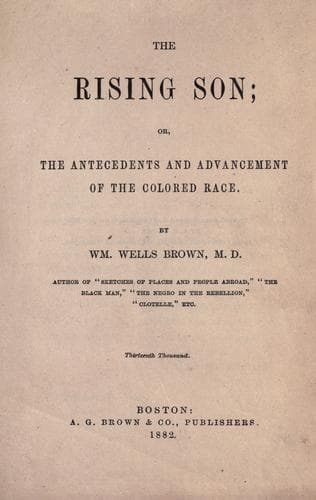
The Rising Son; or, the Antecedents and Advancement of the Colored RaceBrown, William Wells
History
The Rising Son; or, the Antecedents and Advancement of the Colored Race
Brown, William Wells
African Americans -- Biography; African Americans -- History; Black race; Slavery -- United States
“About nine o’clock we procured a hearty supper from the generous
negro, who even gave me his hat,--an appropriate presentation, as one
of my companions remarked, by an ‘intelligent contraband’ to the
reliable gentleman of ‘The New York Tribune.’ The negro did picket-duty
while we hastily ate our meal, and stood by his blazing fire. The old
African and voice and moistened eyes, as we parted from them with
grateful hearts. ‘God bless negroes!’ say I, with earnest lips. During
our entire captivity, and after our escape, they were ever our firm,
brave, unflinching friends. We never made an appeal to them they did
not answer. They never hesitated to do us a service at the risk even of
life; and under the most trying circumstances, revealed a devotion and
a spirit of self-sacrifice that were heroic.
“The magic word ‘Yankee’ opened all their hearts, and elicited the
loftiest virtues. They were ignorant, oppressed, enslaved; but they
always cherished a simple and beautiful faith in the cause of the
Union, and its ultimate triumph, and never abandoned or turned aside
from a man who sought food or shelter on his way to freedom.”
The month of May, 1864, saw great progress in the treatment of
the colored troops by the government of the United States. The
circumstances were more favorable for this change than they had
hitherto been. Slavery had been abolished in the District of Columbia,
Maryland, and Missouri. The heroic assault on Fort Wagner, the
unsurpassed bravery exhibited at Port Hudson, the splendid fighting at
Olustee and Honey Hill, had raised the colored men in the estimation of
the nation. President Lincoln and his advisers had seen their error,
and begun to repair the wrong. The year opened with the appointment
of Dr. A. T. Augusta, a colored gentleman, as surgeon of colored
volunteers, and he was at once assigned to duty, with the rank of
major. Following this, was the appointment, by Governor Andrew,
of Massachusetts, of Sergeant Stephen A. Swailes, of Company F.,
Fifty-fourth Massachusetts Regiment, as second lieutenant.
M. R. Delany, M. D., was soon after appointed a major of negro
volunteers, and assigned to duty at Charleston, South Carolina. W. P.
Powell, Jr., received an appointment as surgeon, about the same time.
The steamer Planter, since being brought out of Charleston by Robert
Small, was under the command of a Yankee, who, being ordered to do
service where the vessel would be liable to come under the fire of
rebel guns, refused to obey; whereupon Lieutenant-Colonel Elwell,
without consultation with any higher authority, issued an order,
placing Robert Small in command of the “Planter.”
Public-domain text, read in full here on John Shaqi.
Reviews
Reviews
No reviews yet
Be the first to share your thoughts on this work.
Elsewhere in the archive
Join the Discussion
Join the discussion
Sign in to leave a comment or review.
Sign InorCreate an account