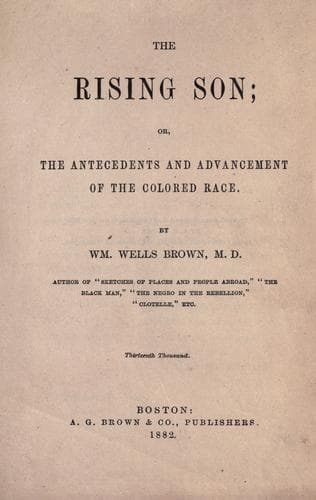
The Rising Son; or, the Antecedents and Advancement of the Colored RaceBrown, William Wells
History
The Rising Son; or, the Antecedents and Advancement of the Colored Race
Brown, William Wells
African Americans -- Biography; African Americans -- History; Black race; Slavery -- United States
Born in Boston, educated in her unsurpassed schools, a graduate of
Harvard University, and deeply imbued with the spirit and teachings
of the great leader of our salvation, and a philanthropist by nature,
Samuel J. May was drawn to the side of Mr. Garrison by the force of
sympathy. He was a member of the Philadelphia Convention in 1833,
at the formation of the American Anti-slavery Society, and his name
is appended to the immortal “Declaration of Sentiments,” penned by
Garrison, his life-long friend. When Prudence Crandall was imprisoned
at Canterbury, Connecticut, for the crime of teaching colored girls
to read, her most attached friend was Samuel J. May. He defended the
persecuted woman, and stood by her till she was liberated. Although
closely confined to his duties as preacher of the Gospel, Mr. May
gave much of his time to the slaves’ cause. As a speaker, he was
always interesting; for his sweet spirit and loving nature won to him
the affectionate regard of all with whom he came in contact. As an
Abolitionist, none were more true, more fearless. His house was long
the home of the fugitive slaves passing through Syracuse, New York, and
his church was always open to the anti-slavery lecturer when others
were shut against him.
Lydia Maria Child early embraced the cause of the enslaved negro. Her
sketches of some of the intellectual characters of the race appeared
more than thirty years ago, and created considerable sensation from the
boldness with which she advocated the black man’s equality.
James and Lucretia Mott were amongst the first in Pennsylvania to take
the stand by the side of Mr. Garrison in defence of negro freedom.
They were Abolitionists in every sense of the term, even to their
clothing and food, for they were amongst the earliest to encourage the
introduction of free-labor goods as a means of breaking up slavery,
by reducing the value of the products of the slave’s toil. As a
speaker, Mrs. Mott was doubtless the most eloquent woman that America
ever produced. A highly-cultivated and reflective mind, thoroughly
conversant with the negro’s suffering, hating everything that savored
of oppression, whether religiously or politically, and possessing the
brain and the courage, Mrs. Mott’s speeches were always listened to
with the closest attention and the greatest interest.
Mr. Mott took little or no part in public gatherings; but his
suggestions on committees, and his advice generally, were reliable. He
gave of his means liberally, and seconded every movement of his noble
wife.
Public-domain text, read in full here on John Shaqi.
Reviews
Reviews
No reviews yet
Be the first to share your thoughts on this work.
Elsewhere in the archive
Join the Discussion
Join the discussion
Sign in to leave a comment or review.
Sign InorCreate an account