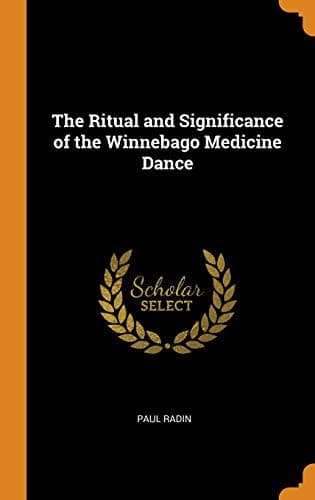
The ritual and significance of the Winnebago medicine danceRadin, Paul
Religion
The ritual and significance of the Winnebago medicine dance
Radin, Paul
Thesis (Ph. D.); Winnebago Indians -- Rites and ceremonies
The ceremonies begin by calling the candidate forward to stand before
the mide of the first group. His family and friends stand around him
in a semicircle, dancing in time to the chanting and drumming. One
of the mide begins a chant, at the end of which a pause occurs, and
the candidate and friends resume their seats. The drum is passed in
rotation to the second, third, and fourth mide. As they chant, the
candidate, etc., stands before them. The last of the four then chants
the origin myth of the Midewiwin. The drum is now passed to the mide
who had chanted first. He continues the narration of the ritualistic
myths. Drum and gourds are then passed from one mide to the other, and
from the first set of mide to the third, until the circuit has been
made.
These ceremonies are continued through the night, although only the
three sets of mide remain in the lodge all that time. Shortly after
sunrise, almost all leave the lodge. When they return, preparations
are made for the initiation. The shooting of the candidate is
performed by the second set of mide. The candidate, after recovering,
makes the circuit of the lodge, shooting whomsoever he desires. The
characteristics of this shooting ceremony are practically identical
with those of the Winnebago.
D. THE SIGNIFICANCE OF THE RITUAL
I. THE COMMON ELEMENTS.—The common elements in the foregoing
ritualistic complexes are both general and specific in nature. We have,
as general, an initiation ritual; and as specific, a shooting ritual.
There are in addition, in the Central Algonkin and Winnebago group,
other resemblances, such as similarities in the ethical teaching, in
the details of the shooting ritual itself, and in the presence of the
secret brush ritual. To the above must be added the fact that the songs
of the Winnebago ceremonies are to a large extent in some Central
Algonkin dialect.
The meaning of these general similarities will be touched upon later.
What I wish to insist upon here is, that if the ritualistic complexes
are at all to be regarded as identical, this is so by reason of the
presence in each of a shooting ritual. This identity is strengthened
in each case by the association of this specific shooting ritual with
the more general feature of initiation. The most dramatic phase in the
main ceremony is this initiation and shooting complex; and it seems,
therefore, quite intelligible why the number of similar details thus
associated together should have been interpreted as the historically
primary and basic elements.
Public-domain text, read in full here on John Shaqi.
Reviews
Reviews
No reviews yet
Be the first to share your thoughts on this work.
Join the Discussion
Join the discussion
Sign in to leave a comment or review.
Sign InorCreate an account