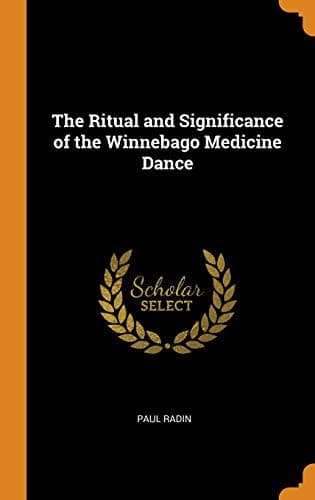
The ritual and significance of the Winnebago medicine danceRadin, Paul
Religion
The ritual and significance of the Winnebago medicine dance
Radin, Paul
Thesis (Ph. D.); Winnebago Indians -- Rites and ceremonies
There are two ways in which a man can join the Medicine Dance. He
may simply apply for admission to any of the five leaders, or he may
take the place of a deceased relative. In the former case, if his
payment is satisfactory, and he has the other qualifications, he is
accepted. In the other case, he or his relatives decide to have him
take the place of a deceased relative. This latter form of candidacy
is by far the commoner. At the present day, initiation requires the
payment of about three hundred or four hundred dollars, in the form of
goods and tobacco. Of this, a portion is given to the leader of the
Ancestor-Host’s Band during the Four Nights’ Preparation, and the rest
to the leaders of the other four bands during the ceremony proper.
Exactly how much information an individual obtains on entering, cannot
be determined. This would depend on the amount of the payment. The
minimum of knowledge would be an acquaintance with the bare externals
of the ceremony, its general significance, and such knowledge of the
legendary origin of the Lodge as a single recital could give. The new
member is not initiated into the symbolism of the ritualistic myths,
and consequently a large portion of the same must be unintelligible
to him. What he obtains is practically only the right to hold the
otter-skin bag and to use it in a certain way. He cannot take part in
any of the forms of dancing or singing, nor can he even shoot at will.
He very rarely remains in this condition long, but takes the first
opportunity to purchase additional knowledge and privileges.
There are three kinds of members,—mature men, women, and children. The
privileges of women differ from those of the men, in that the women do
not have to partake of the sweat-bath, may never become assistants, and
are privileged to dance in a certain way. In other respects they have
equal privileges with men. In practice, there are certain privileges
that women never have, but this is due to the fact that either they do
not care or they are not in a position to buy them. Children belong to
a quite different category. Although they possess an otter-skin, they
have not even the power of making it effective, and, in order to do so,
must have it guided by some older member. There does not seem to be any
evidence indicating that women were ever excluded from membership.
II. PRESCRIBED DUTIES OF THE BANDS.—The duties of the
host, who is known as x’okera,[2] and whose band is called
Minañk‘ara-k‘oñañgire′ra,[3] are as follows:
1. To rehearse the songs and rituals with his band four nights
previous to the ceremony proper. At this rehearsal the candidate
(haⁿbirok‘aragu′-inera, literally “the one for whom they seek life”) is
always present, and instructed in the ceremony.
2. To send out invitation-sticks and tobacco to the leaders of the
other four bands. The messengers are always his sisters’ sons.
3. To begin the Four Nights’ Ceremony preceding the ceremony proper.
Public-domain text, read in full here on John Shaqi.
Reviews
Reviews
No reviews yet
Be the first to share your thoughts on this work.
Join the Discussion
Join the discussion
Sign in to leave a comment or review.
Sign InorCreate an account