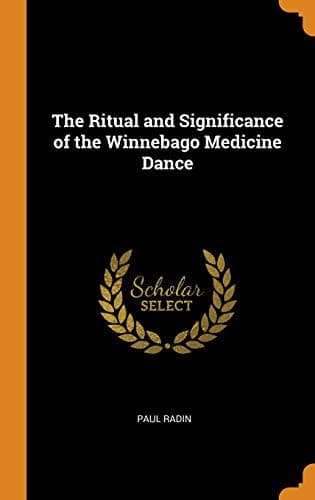
The ritual and significance of the Winnebago medicine danceRadin, Paul
Religion
The ritual and significance of the Winnebago medicine dance
Radin, Paul
Thesis (Ph. D.); Winnebago Indians -- Rites and ceremonies
2. _TYPES OF SONGS._—The songs may be divided into two groups: (1)
those that are sung in connection with myths and after the speeches
of a more general nature, and (2) those that are sung to accompany
definite and specific actions. These latter can therefore be most
conveniently divided into (_a_) minor dance songs, (_b_) major dance
songs, (_c_) initial songs, (_d_) terminal songs, (_e_) loading
songs, and (_f_) shooting songs. The medicine-men distinguish only
between four kinds of songs,—major and minor dance songs, terminal and
shooting songs. Each has a different rhythm and music. For purposes of
description, however, the above division is more convenient.
3. _TYPES OF ACTION._ (1) _Blessing._—Either hand is held outstretched,
palm downward, and moved horizontally through the air. It is always
used when entering and leaving the lodge, and on any occasion where an
individual has to pass from one part of the lodge to another. It is
always rendered as “blessing” by the Indians; and they particularly
insisted upon the fact that the “blessing” was not conveyed by any
words used in connection with the action, but by the action itself.
Each person who is thus passed answered with a long-drawn-out “ho-o-o,”
and with an obeisance of the head.
A modification of the above is the naⁿsura niñkuruhintce (or “blessing
of the head”), which consists of a simple laying of the hand upon the
head; both the giver and recipient keeping their eyes fixed on the
ground, and the recipient slightly bending his head. A few mumbled
words accompany this action.
(2) _Direction of Walking in the Lodge._—One must always pass contrary
to the hands of the clock. A person in the East Band must make the
entire circuit of the lodge in order to pass out. In only exceptional
cases can this rule of passing be broken; and that is when an old and
specially privileged member crosses from his seat to that directly
opposite him, during the shooting ceremony. I was given to understand
that this was an extremely expensive privilege.
4. _TYPES OF RITUAL._—Parts III, IV, and V can be so analyzed that they
fall into a fairly well-defined number of complexes, consisting of
speeches, songs, and movements. These are nine in number. Artificial
distinctions have been avoided in this division, as far as possible.
The complexes are (1) entrance ritual; (2) exit ritual; (3) fire
ritual; (4) presentation-of-food ritual; (5) shooting ritual; (6)
initiation ritual; (7) sweat-lodge ritual; (8) smoking ritual; (9)
basic ritual.
Public-domain text, read in full here on John Shaqi.
Reviews
Reviews
No reviews yet
Be the first to share your thoughts on this work.
Join the Discussion
Join the discussion
Sign in to leave a comment or review.
Sign InorCreate an account