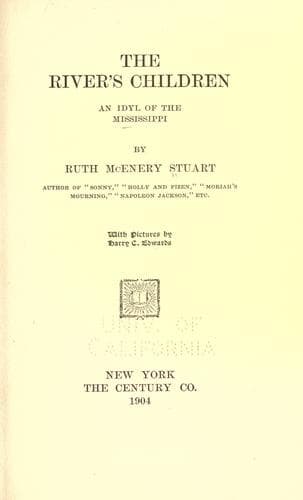
The River's Children: An Idyl of the MississippiStuart, Ruth McEnery
General
The River's Children: An Idyl of the Mississippi
Stuart, Ruth McEnery
African Americans -- Fiction; Conduct of life -- Fiction; Mississippi River -- Fiction; Poverty -- Fiction
Brake Island, so called because of its situation in a dense cane-brake,
which was at once a menace and a guard, was the most unpopular part of
the colonel's large estate, albeit there was no land so rich as its
fields, no wood better stocked with game than the narrow forest lying
close along its northern limit, no streams more picturesque in their
windings or better equipped for the angler's art than that of the Bayou
d'Iris, whose purple banks declared the spring while the robins were
calling, and before the young mocking-birds in the crape myrtles opened
their great red mouths for the wriggling song-food of the bayou's brim.
All the Le Duc sons had loved to go to the island to shoot and to fish
while they were lads, but upon attaining the social age they had grown
to despise it for its loneliness. The brake which fringed its borders
had long been a refuge for runaway negroes, who were often forced to
poach upon its preserves for food, even to the extent of an occasional
raid upon its smoke-houses and barns, so that women and children were
wont to shudder at the very idea of living there. Still it had always
been the declared "favorite spot on earth" to the colonel, who had often
vowed that no son of his should own it and spurn it.
He lived like a lord himself, it is true, on a broader place of less
beauty on the bank of the great river,--"keeping one foot in New Orleans
and one on the plantation," as he expressed it,--and it is not
surprising that his children had laughingly protested against being
brought up on house-parties and the opera as preparation for a hermit's
life, even in "Paradise."
All excepting Harold. While the brothers had protested against the
island home, he had said little, but when he had brought his bride home,
and realized the scant affection that stirred the hearts of his family
at sight of her placid New England face, even while he himself suffered
much, knowing that her brothers were enlisting in the opposing armies
and that her family felt her marriage at this time to a slaveholder as a
poignant sorrow--while the father seemed hesitating as to just what
paternal provision he should make for his impulsive boy, the boy
himself, in a sudden towering declaration of his manhood and of
resentment and pride, turned upon him:
"Give us Brake Island and Mammy and Israel, and cut us loose! And I'll
show my people a new variety of hermit life!"
The thing was quickly done. A deed of gift made on the spot conveyed
this Eden of modern times, with its improvements, full working force and
equipment, to Harold Guyoso Le Duc, who in accepting it assumed the one
condition of making it his home.
III
Public-domain text, read in full here on John Shaqi.
Reviews
Reviews
No reviews yet
Be the first to share your thoughts on this work.
Join the Discussion
Join the discussion
Sign in to leave a comment or review.
Sign InorCreate an account