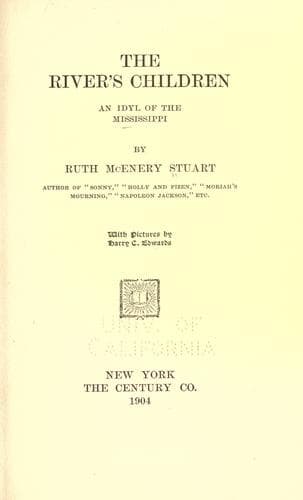
The River's Children: An Idyl of the Mississippi — John Shaqi
The River's Children: An Idyl of the MississippiStuart, Ruth McEnery
General
The River's Children: An Idyl of the Mississippi
Stuart, Ruth McEnery
African Americans -- Fiction; Conduct of life -- Fiction; Mississippi River -- Fiction; Poverty -- Fiction
Harold was a brilliant fellow, impulsive and extravagant as he was
handsome and loving, and he had no sooner taken possession of his Eden
than he began to plan, by means of a system of engineering, to open it
up by a canal which should "span the brake and tap the bayou," so that
boats of size and circumstance might enter. Here he would have a launch
and a barge, and the great world of culture, of wit, of pleasure, and of
affluence should come in splendor "to watch a hermit herm," or, as he as
often put it, "to help a hummit hum."
A great house-party was quickly arranged--a party of gay friends,
engineers chiefly, bidden for a freely declared purpose--a party which
is still cherished in the annals of local social history as a typical
example of affluent ante-bellum hospitality, and is even yet personally
recalled by a few old men who sit and seem to wait, mostly, in shabby
clothing incongruously ill fitting their gilded reminiscence, at certain
dozing business resorts in old New Orleans.
Most of these venerables still live in their shabby ancestral homes,
although it may be their women take boarders or their best rooms are let
for business purposes--cleared of their cumbersome furnishings of
mahogany and rosewood by the rising waters of misfortune which have
gradually carried them into the "antique-shops" of the vicinity.
A place of honor on the tax-lists and a waiting palace of white marble
in the cemetery--these querulous witnesses to distinction and of
permanency are in some cases the sole survivors of the many changes
incident upon a reconstruction.
To these gentle reminiscers the "Brake Island house-party of Harold Le
Duc" is even yet the Procrustean bed against which they measure all the
ostentatious pageantry of a new and despised social order.
For the possible preservation of a bit of local color--gone out in the
changed light of a new dispensation--behold a hasty sketch of this
long-ago playtime. The invitations which were sent out, naming a single
date only, with the flattering implication that the visit so urgently
desired might never come to an end,--one of the easy fashions of the old
regime,--promptly brought a dozen men, with as many women, wives and
sweethearts, to the "big house" beyond the swamp.
This Southern home, which was broadly typical of its class, simple
enough in its architecture in that its available space, barring the
watch-tower in the center of its roof, was all upon a single floor and
its material the indigenous woods of the forest, yet suffered no
diminution in being called the "big house"--a name which has been made
to serve many a lesser structure for purposes of distinction.
Set high upon brick pillars,--there are no cellars possible in the
Mississippi valley country,--its low, spreading form graced the easy
eminence upon which it stood, dominating its wide demesne with a quiet
dignity superior to that of many a statelier home.
Public-domain text, read in full here on John Shaqi.
Reviews
Reviews
No reviews yet
Be the first to share your thoughts on this work.
Join the Discussion
Join the discussion
Sign in to leave a comment or review.
Sign InorCreate an account