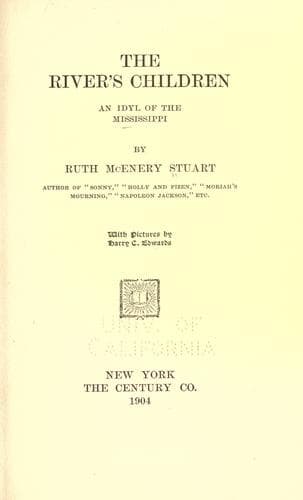
The River's Children: An Idyl of the Mississippi — John Shaqi
The River's Children: An Idyl of the MississippiStuart, Ruth McEnery
General
The River's Children: An Idyl of the Mississippi
Stuart, Ruth McEnery
African Americans -- Fiction; Conduct of life -- Fiction; Mississippi River -- Fiction; Poverty -- Fiction
It is easy to start a laugh when a festive crowd is primed for fun, and
this toast, respectfully submitted with a low bow by an ancient and
privileged veteran of the rosined bow, was met with screams of delight.
V
A resourceful little island it was that could provide entertainment for
a party of society folk for nearly a fortnight with never a repetition
to pall or to weary.
The men, equipped for hunting or fishing, and accompanied by several
negro men-servants with a supplementary larder on wheels,--which is to
say, a wagon-load of bread, butter, coffee, condiments, and wines, with
cooking utensils,--left the house early every morning, before the ladies
were up.
They discussed engineering schemes over their fishing-poles and
game-bags, explored the fastnesses of the brake, eavesdropped for the
ultimate secret of the woods, and plumbed for the bayou's heart,
bringing from them all sundry tangible witnesses of geologic or other
conditions of scientific values.
Most of these "witnesses," however, it must be confessed, were
immediately available for spit or grill, while many went--so bountiful
was the supply--to friends in the city with the cards of their captors.
There are champagne bottles even yet along the marshes of Brake Island,
bottles whose bellies are as full of suggestion as of mud, and whose
tongueless mouths fairly whistle as if to recount the canards which
enlivened the swampland in those halcyon days of youth and hope and
inexperience.
Until the dressing-hour, in the early afternoons which they frankly
called the evening, the young women coddled their bloom in linen cambric
night-gowns, mostly, reading light romance and verse, which they quoted
freely under the challenge of the masculine presence.
Or they told amazing mammy-tales of voudoo-land and the ghost-country
for the amused delectation of their gentle hostess, who felt herself
warmed and cheered in the sunshine of these Southern temperaments. It
seemed all a part of the poetry and grace of a novel and romantic life.
Here were a dozen young women, pretty and care-free as flowers, any one
of whom could throw herself across the foot of a bed and snatch a
superfluous "beauty-sleep" in the midst of all manner of jollity and
laughter.
Most of them spoke several languages and as many dialects, frequently
passing from one to another in a single sentence for easy subtlety or
color, and with distinct gain in the direction of music.
Possibly they knew somewhat of the grammar of but a single tongue beside
their own, their fluency being more of a traditional inheritance than an
acquisition. Such is the mellow equipment of many of our richest
speakers.
Not one but could pull to pieces her Olympe bonnet and nimbly retrim it
with pins, to match her face or fancy--or dance a Highland fling in her
'broidered nightie, or sing--
Public-domain text, read in full here on John Shaqi.
Reviews
Reviews
No reviews yet
Be the first to share your thoughts on this work.
Join the Discussion
Join the discussion
Sign in to leave a comment or review.
Sign InorCreate an account