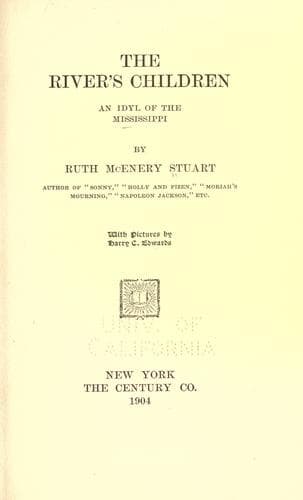
The River's Children: An Idyl of the MississippiStuart, Ruth McEnery
General
The River's Children: An Idyl of the Mississippi
Stuart, Ruth McEnery
African Americans -- Fiction; Conduct of life -- Fiction; Mississippi River -- Fiction; Poverty -- Fiction
When he reached the homestead, he found it wholly deserted. The "big
house," sacred to superstition through its succession of tragedies, was
as Mammy and Israel had left it. Even its larder was untouched, and the
key of the wine-cellar lay imbedded in rust in sight of the cob-webbed
door.
It was a sad man, prematurely gray, and still gaunt--and white with the
pallor of the hospital prison--who, after this sorrowful pilgrimage to
Brake Island, appeared, as from the grave, upon the streets of New
Orleans. When he was reinstated in his broken home, and known once more
of his family and friends, he would easily have become the popular hero
of the hour, for the gay world flung its gilded doors open to him.
The Latin temperament of old New Orleans kept always a song in her
throat, even through all the sad passages of her history; and there was
never a year when the French quarter, coquette that she was, did not
shake her flounces and dance for a season with her dainty toes against
the lower side of Canal Street.
But Harold was not a fellow of forgetful mind. The arch of his life was
broken, it is true, but like that of the bridge he had begun--a bridge
which was to invite the gay world, yes, but which would ever have
dominated it, letting its sails pass under--he could be no other than a
worthy ruin. Had his impetuous temper turned upon himself on his return
to the island, where devastation seemed to mock him at every turn, there
is no telling where it might have driven him. But a lonely mother, and
the knowledge that his father had died of a broken heart upon the report
of his death, the last of his three sons--the pathetic, dependence of
his mother upon him--the appeal of her doting eyes and the exigencies of
an almost hopeless financial confusion--all these combined as a
challenge to his manhood to take the helm in the management of a wrecked
estate.
It was a saving situation. How often is work the great savior of men!
Once stirred in the direction of effort, Harold soon developed great
genius for the manipulation of affairs. Reorganization began with his
control.
Square-shouldered and straight as an Indian, clear of profile,
deep-eyed, and thoughtful of visage, the young man with the white hair
was soon a marked figure. When even serious men "went foolish over him,"
it is not surprising that ambitious mothers of marriageable daughters,
in these scant days of dearth of men, should have exhibited occasional
fluttering anxieties while they placed their broken fortunes in his
hands.
Reluctantly at first, but afterward seeing his way through experience,
Harold became authorized agent for some of the best properties along the
river, saving what was left, and sometimes even recovering whole estates
for the women in black who had known before only how to be good and
beautiful in the romantic homes and gardens whose pervading perfume had
been that of the orange-blossom.
Public-domain text, read in full here on John Shaqi.
Reviews
Reviews
No reviews yet
Be the first to share your thoughts on this work.
Join the Discussion
Join the discussion
Sign in to leave a comment or review.
Sign InorCreate an account