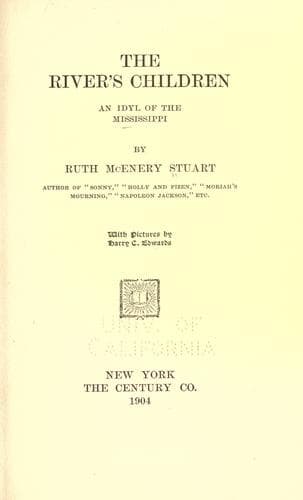
The River's Children: An Idyl of the MississippiStuart, Ruth McEnery
General
The River's Children: An Idyl of the Mississippi
Stuart, Ruth McEnery
African Americans -- Fiction; Conduct of life -- Fiction; Mississippi River -- Fiction; Poverty -- Fiction
This was to be their last night here. Harold was to bring a carriage on
the next day to take them to his mother and Blossom, and, despite the
joy in their old hearts, it cost them a pang to contemplate going away.
Every woodpile seemed to hold a memory, each feature of the bank a
tender association. Blucher lay sleeping beside them.
Israel spoke first.
"Hannah!" he said.
"What, Isrul?"
"I ready to go home to-night, Hannah. Marse Harol' done come. We done
finished our 'sponsibility--an' de big river's a-flowin' on to de
sea--an' settin' heah, I 'magines I kin see Mis' Aggie lookin' down on
us, an' seem like she mought want to consult wid us arter our meetin'
wid Marse Harol' an' we passin' Blossom along. What you say, Hannah?"
"I been tired, ole man, an' ef we could 'a' went las' night, like you
say, seem like I 'd 'a' been ready--an', of co'se, I'm ready now, ef
Gord wills. Peace is on my sperit. Yit an' still, when we rests off a
little an' studies freedom free-handed, we won't want to hasten along
maybe. Ef we was to set heah an' wait tell Gord calls us,--He ain't ap'
to call us bofe together, an' dey'd be lonesome days for the last one.
But ef we goes 'long wid Marse Harol', he an' Blossom'll be a heap o'
comfort to de one what's left."
"Hannah!"
"Yas, Isrul."
"We's a-settin' to-night close to de brink--ain't dat so?"
"Yas, Isrul."
"An' de deep waters is in sight, eh, Hannah?"
"Yas, Isrul."
"An' we heah it singin', ef we listen close, eh, Hannah?"
"Yas, Isrul."
"Well, don't let 's forgit it, dat 's all. Don't let's forgit, when we
turns our backs on dis swellin' tide, dat de river o' Jordan is jes
befo' us, all de same--an' it can't be long befo' our crossin'-time."
"Amen!" said the woman.
* * * * *
The moon shone full upon the great river, making a shimmering path of
light from shore to shore, when the old couple slowly rose and went to
rest.
Toward morning there was a quick gurgling sound in front of the cabin.
Blucher caught it, and, springing out, barked at the stars. The sleepers
within the levee hut slept on, being overweary.
The watchman in the Carrollton garden heard the sound,--heard it swell
almost to a roar,--and he ran to the new levee, reaching its summit just
in time to see the roof of the cabin as it sank, with the entire point
of land upon which it rested, into the greedy flood.
* * * * *
When Harold Le Duc arrived that morning to take the old people home, the
river came to meet him at the brim of the near bank, and its face was as
the face of smiling innocence.
While he stood awe-stricken before the awful fact so tragically
expressed in the river's bland denial, a wet dog came, and, whining,
crouched at his feet. He barked softly, laid his head a moment upon his
master's boot, moaned a sort of confidential note, and, looking into the
air, barked again, softly.
Public-domain text, read in full here on John Shaqi.
Reviews
Reviews
No reviews yet
Be the first to share your thoughts on this work.
Join the Discussion
Join the discussion
Sign in to leave a comment or review.
Sign InorCreate an account