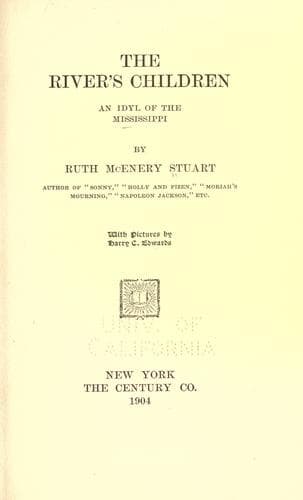
The River's Children: An Idyl of the MississippiStuart, Ruth McEnery
General
The River's Children: An Idyl of the Mississippi
Stuart, Ruth McEnery
African Americans -- Fiction; Conduct of life -- Fiction; Mississippi River -- Fiction; Poverty -- Fiction
This magnetic quality--one hesitates to use an expression so nervously
prostrated by strenuous overwork, and yet it is well made and to
hand--this magnetic quality, then, was probably, in Agnes Le Duc, the
gift of the Latin strain grafted upon New England sturdiness and
reserve, the one answering, as one might say, for ballast, while the
other lent sail for the equable poising of a safe and brilliant
life-craft.
So, also, was her unusual beauty markedly a composite and of elements so
finely contrasting that their harmonizing seemed rather a succession of
flashes, as of opposite electric currents meeting and breaking through
the caprice of temperamental disturbance; as in the smile which won by
its witchery, or the illumination with which rapid thought or sudden
pity kindled her eye.
Educated alternately in Louisiana where she had recited her history
lessons in French, and in New England, the pride and pet of a charmed
Cambridge circle, with occasional trips abroad with her "parents," she
was emerging, all unknowingly, a rather exceptional young woman for any
place or time.
Seeing her this evening, an enthusiast might have likened her to the
exquisite bud of a great tea-rose, regal on a slender stem--shy of
unfolding, yet ultimately unafraid, even through the dewy veil of
immaturity--knowing full well, though she might not stop to remember,
the line of court roses in her pedigree.
Watching her so at a safe distance, one could not help wondering that
she thought it worth her while to listen at all, seeing how her admirers
waited upon her every utterance. To listen well has long been considered
a grace--just to listen; but there is a still higher art, perhaps, in
going a step beyond. It is to listen with enthusiasm, yes, even with
_eloquence_. One having a genius for this sort of oratory, speaking
through the inspired utterance of another, and of course supplying the
inspiration, gains easily the reputation of "delightful conversational
powers."
And this was precisely an unsuspected quality which made for the sweet
girl much of the popularity which she had never analyzed or questioned.
She _could_ talk, and in several languages, familiarly, and when the
invitation arrived, she did--upward, with respect, to her elders (she
had learned that both in New Orleans and in Boston); downward to her
inferiors--with gentle directness, unmixed with over-condescension; to
right and to left among her companions, quite as a free-hearted girl,
with spirit and _camaraderie_.
A quality, this, presaging social success certainly, and, it must be
admitted, it is a quality which sometimes adorns natures wanting in
depth of affection. That this was not true of Agnes Le Duc, however,
seems to be clearly shown in an incident of this trip.
Public-domain text, read in full here on John Shaqi.
Reviews
Reviews
No reviews yet
Be the first to share your thoughts on this work.
Join the Discussion
Join the discussion
Sign in to leave a comment or review.
Sign InorCreate an account