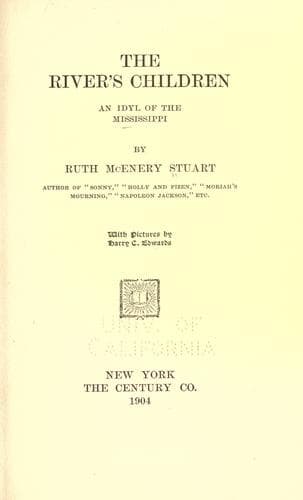
The River's Children: An Idyl of the Mississippi — John Shaqi
The River's Children: An Idyl of the MississippiStuart, Ruth McEnery
General
The River's Children: An Idyl of the Mississippi
Stuart, Ruth McEnery
African Americans -- Fiction; Conduct of life -- Fiction; Mississippi River -- Fiction; Poverty -- Fiction
Even a certain slight maternal wisp who bent over a tiny waxen thing
upon her lap, dreading each moment to perceive the flicker in her breath
which would show that a flame went out--even she, poor tear-dimmed soul,
said it while she answered sympathetic inquiry:
"Oh, yas; it is for her we are taking de trip. Yas, she is very sick,
_mais God is good_. It is de eye-teet'. De river's breath it is de bes'
medicine. De doctor he prescribe it. An' my father he had las' winter
such a so much trouble to work his heart, an' so, seeing we were coming,
he is also here--yas, dat's heem yonder, asleep. 'T is his most best
sleep for a year, lying so. De river she give it. An' dose ferryboat dey
got always on board too much whooping-cough to fasten on to eye-teet."
* * * * *
Somewhat apart from the other passengers, their circle loosely but
surely defined by the irregular setting of their chairs toward a common
center, sat a group, evidently of the great world--most conspicuous
among them a distinguished-looking couple in fresh mid-life, who led the
animated discussion, and who were seen often to look in the direction of
a tall and beautiful girl who stood in the midst of a circle of young
people within easy call. It was impossible not to see that their
interest in the girl was vital, for they often exchanged glances when
her laughter filled the air, and laughed with her, although they knew
only that she had laughed.
The girl stood well in sight, although "surrounded six deep" by an
adoring crowd; nor was this attributable alone to her height which set
her fine little head above most of her companions. A certain distinction
of manner--unrelated to haughtiness, which may fail in effect, or
arrogance, which may over-ride but never appeal; perhaps it was a
graciousness of bearing--kept her admirers ever at a tasteful distance.
There was an ineffable charm about the girl, a thing apart from the
unusual beauty which marked her in any gathering of which she became a
part.
Descriptions are hazardous and available words often inadequate to the
veracious presentment of beauty, and yet there is ever in perfection a
challenge to the pen.
As the maiden stood this evening in the sunlight, her radiant yellow
hair complementing the blue of her sea-deep eyes, her fair cheeks
aglow, and one color melting to another in her quick movements, the
effect was almost like an iridescence. Tender in tints as a sea-shell,
there might have been danger of lapse into insipidity but for the accent
of dark rims and curled lashes which individualized the eyes, and, too,
the strong, straight lines of her contour, which, more than the note of
dark color, marked her a Le Duc.
There are some women who naturally hold court, no matter what the
conditions of life, and to whom tribute comes as naturally as the air
they breathe. It often dates back into their spelling-class days, and I
am not sure that it does not occasionally begin in the "perambulator."
Public-domain text, read in full here on John Shaqi.
Reviews
Reviews
No reviews yet
Be the first to share your thoughts on this work.
Join the Discussion
Join the discussion
Sign in to leave a comment or review.
Sign InorCreate an account