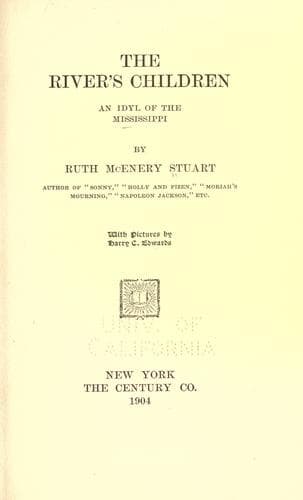
The River's Children: An Idyl of the Mississippi — John Shaqi
The River's Children: An Idyl of the MississippiStuart, Ruth McEnery
General
The River's Children: An Idyl of the Mississippi
Stuart, Ruth McEnery
African Americans -- Fiction; Conduct of life -- Fiction; Mississippi River -- Fiction; Poverty -- Fiction
"Tell de trut', I don't like dat dancing on de supper-table, Felix. 'T
is super_flu_ous. De floor is good enough. An' you know, w'en a lady is
dancing on a table, after a good supper, of co'se every glass is a
temptation to her slipper. An' slippers an' wine-glasses--well, to say
de least, de combination it is disastrous.
"So, I say, de floor it is good enough for me. It seem more _comme il
faut_.
"_Mais_ come along. We will be late."
PART SECOND
I
"Sing, nigger, sing! Sing yo' rhyme!
De waters is a-floodin'--dey 's a-roarin' on time!
Climb, squirrel, climb!"
For several miles, when the night was still or the wind favorable, one
could follow the song, accented by simultaneous blows of implements of
defense marking the measure.
"Sing, nigger, sing! Sing an' pray!
Ol' Death is on de water--he's a-ridin' dis way!
Pray, nigger, pray!"
Some of the words might have been elusive had they been unfamiliar, but
the annual agitation kept the songs of the river in mind; and even in
safe sections, where many sat in peace beside the rising waters, they
would take their pipes from their lips to catch up the danger-songs and
sympathetically pass them along. Many a prayer went with them, too, from
humble petitioners who knew whereof they prayed.
Such were an old black couple who sat one night upon the brow of the
outer levee at Carrollton, since become an upper district of
far-reaching New Orleans.
In strong contrast to the stirring scenes enacting below the city, all
was peace and tranquillity here. A strong, new embankment, securely
built several hundred feet inland, had some years before supplanted the
outer levee, condemned as insecure, so that the white inhabitants of the
suburb slept, intelligently safe behind a double barrier, for the
condemned bank had stood the stress of so many seasons that much of the
low land lying between the two levees was finally occupied by squatters,
mostly negroes, this being free space, taking no rent of such as did not
fear the ever-impending mortgage which the river held.
Of this class, quite apart from others, might have been seen almost any
evening the old couple, Hannah and Israel, sitting upon the brow of the
levee near the door of their low cabin, while, always within call, there
played about them a fair-haired little girl and a dog.
When the beautiful child, followed by the dog, a fine Irish setter,
would suddenly emerge in a chase from among the woodpiles about the
cabin, there was a certain high-bred distinction in them both which set
them apart from the rest of the picture.
Public-domain text, read in full here on John Shaqi.
Reviews
Reviews
No reviews yet
Be the first to share your thoughts on this work.
Join the Discussion
Join the discussion
Sign in to leave a comment or review.
Sign InorCreate an account