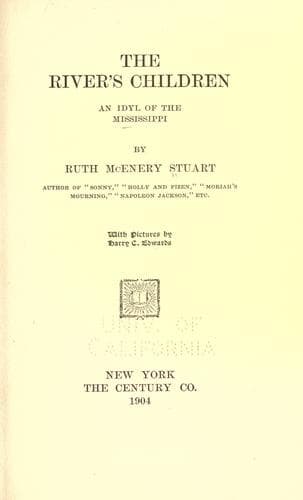
The River's Children: An Idyl of the Mississippi — John Shaqi
The River's Children: An Idyl of the MississippiStuart, Ruth McEnery
General
The River's Children: An Idyl of the Mississippi
Stuart, Ruth McEnery
African Americans -- Fiction; Conduct of life -- Fiction; Mississippi River -- Fiction; Poverty -- Fiction
Sometimes they would "play too hearty," as Mammy expressed it, and she
would call: "Dat 'll do now, Blossom! Come lay down, Blucher!" and,
followed closely by the dog, the child would coddle at the knees of the
woman, who "made the time pass" with stories. Sometimes these would be
folk-tales brought over from Africa, or reminiscences of plantation
life, but more often, feeling her religious responsibility to the
little one, old Hannah would repeat such Bible stories as "befitted a
child's mind," such as "Ab'um an' Isaac," "Eden's Gyarden," or "De
Prodigum Son."
Of them all, the Eden story was easily favorite, its salient mystery
features affording fine scope for the narrator's power, while they held
the imaginative child with the spell of all good wonder-tales. We get
these stories so young and grow up with them so familiarly that when we
finally come into a realization of them they hold no possible surprise
and so their first charm is lost. Think of one story with such elements
as a wonder-woman rising from a man's side while he slept--a talking
serpent, persuasive in temptation as insidious in easy approaches--a
flaming sword of wrath--a tree of knowledge--and the sounding voice of
God as he walked through the garden "in the cool of the day"! Is not a
single colloquialism of so venerable ancestry sufficient to dignify a
language?
Herself a classic in that she expressed the eternal quality of maternal
love incarnate, the old woman thus unconsciously passed along to the
object of her devotion the best classic lore of the ages. And sunrise
and sunset, star- and moon-land, and their reflection in the great
water-mirror, were hers and the child's, without the asking. Nor were
they lost, although to both child and woman they were only common
elements in life's great benediction.
During the story-telling, which generally lasted until the sun sank
across the river, but while its last rays still made "pictures of glory
in the heavens" with the water's reflection,--pictures which served to
illustrate many a narration, to inspire the speaker and impress a
sensitive child,--the dog would stretch himself facing the two, and his
intelligent and quizzical expression would sometimes make Mammy laugh in
a serious place or change the drift of her story. Often, indeed, this
had happened in the telling of certain animal tales which Mammy
declared Blucher knew better than she and she even insisted that he
occasionally winked at her and set her right when she went wrong.
In the early dusk, the old man Israel would come trudging in from the
water and sometimes he would light his pipe and join Mammy's audience.
Public-domain text, read in full here on John Shaqi.
Reviews
Reviews
No reviews yet
Be the first to share your thoughts on this work.
Join the Discussion
Join the discussion
Sign in to leave a comment or review.
Sign InorCreate an account