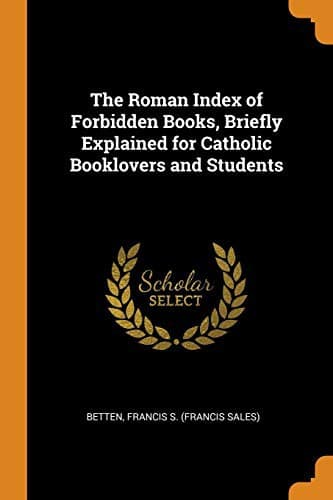
The Roman Index of Forbidden Books: Briefly Explained for Catholic Booklovers and StudentsBetten, Francis S. (Francis Sales)
Religion
The Roman Index of Forbidden Books: Briefly Explained for Catholic Booklovers and Students
Betten, Francis S. (Francis Sales)
Index librorum prohibitorum; Prohibited books
These and similar rules ... must be kept before the minds of the
consultors, in order that they may have due regard for their own
conscience, the good name of authors, the interests of the Church, and
the welfare of souls.”
10. Further Explanations.
A. Why an Author is Not Permitted to Defend His Book.
If an author could accompany every copy of his work that leaves the
bookstore or library, he would be able to explain obscure passages
and to show what meaning he wished doubtful phrases to convey to the
reader. It is precisely because he cannot multiply himself that he
employs printer’s ink to convey his ideas to others. It must,
therefore, be supposed that his words mean what he intends to say. The
reader, at any rate, has no corrective. He has only the book, not the
author to fall back upon. It is impossible to recur to the author when
there is question of the correctness or incorrectness of a book. If
the author has to be called upon to explain the meaning of his book,
he should have left it unprinted.
Moreover, it is hardly credible, as Pope Benedict XIV points out, that
anything an author might advance in his favor, should escape so many
examiners without receiving due attention and emphasis.
The whole procedure is primarily not intended as a measure against the
author, although pecuniary loss _may_ ensue, but to protect the
faithful. A condemnation is rather a warning to the would-be reader,
than a punishment inflicted upon the author. It is not an act of
jurisdiction. Were the author’s personal views under investigation, he
would be summoned personally before another tribunal and tried
according to a method that would give him the amplest opportunity to
defend himself.
These considerations also show that the condemnation of a book after
its author’s death is not unreasonable. A book remains what it is
independently of its author. Nor would it change the nature of a book
were the author afterwards to prove his orthodoxy to the satisfaction
of the authorities, or to do penance in sackcloth and ashes, or for
the rest of his mortal life consort with the Trappists. Were it
morally certain, however, that almost all the copies of a book were
destroyed, a prohibitory decree would fail of its purpose.
B. The Index Does Not Advertise Bad Books.
Now and then there is expressed an apprehension lest the Index, far
from suppressing, rather advertises bad books and arouses a desire to
read them. It is even maintained that in some cases evil-minded
authors have intentionally written so as to get their books put on the
Index.
Public-domain text, read in full here on John Shaqi.
Reviews
Reviews
No reviews yet
Be the first to share your thoughts on this work.
Join the Discussion
Join the discussion
Sign in to leave a comment or review.
Sign InorCreate an account