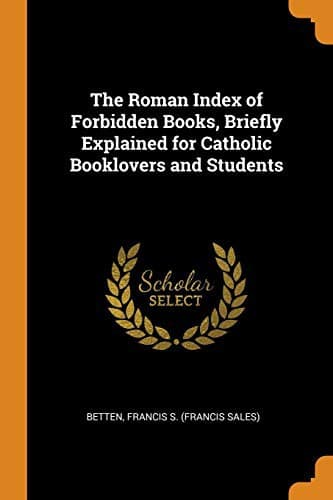
The Roman Index of Forbidden Books: Briefly Explained for Catholic Booklovers and StudentsBetten, Francis S. (Francis Sales)
Religion
The Roman Index of Forbidden Books: Briefly Explained for Catholic Booklovers and Students
Betten, Francis S. (Francis Sales)
Index librorum prohibitorum; Prohibited books
Great care is taken to have all books examined by men who are not only
well versed in the subject matter, but who also understand thoroughly
the language in which they happen to be written. Nor does the
Congregation in important cases confine itself to its regular
consultors; whenever it seems advisable, the services of other
competent critics are enlisted.
All the members of the Congregation are bound by oath to keep absolute
secrecy with regard to every detail of the official transactions, no
matter whether a book under discussion is finally condemned or not. By
this means each feels more free in giving his opinion, and the
reputation of the author is spared as long and as much as possible.
9. The Spirit of the Congregation of the Index.
As to the spirit that should actuate the members of the Congregation
of the Index, the rules laid down for its consultors by Benedict XIV
in the Bull “Sollicita ac provida” are instructive.
“_Ipsos ... monemus ac vehementer hortamur ut in examine iudicioque
librorum sequentes regulas diligenter inspiciant accurateque
custodiant._” “We wish to admonish and exhort them most urgently to
study carefully and observe accurately the following rules for
examining and judging books:
1. Let them not imagine that it is their duty to use every means to
bring about the condemnation of the books submitted to them. They
ought rather to study such books conscientiously, without passion or
anxiety (sedato animo), in order to furnish such well-found
observations, such objective reasons, as will enable the Congregation
to pass a just verdict.
2. Should a consultor find that he is not competent to judge a book
which he is asked to examine, let him know that he will not be free
from guilt, either before God or man, unless he at once confesses his
incompetence. Far from damaging his reputation with the pope or the
cardinals, such an avowal will rather gain their esteem and praise for
his straightforwardness and honesty.
3. Let them set aside absolutely all prejudice in favor of nation,
family, school or order; let them relinquish all party spirit, and
keep before their minds the undoubted doctrine of the Church, as laid
down in the decrees of the councils, in papal documents, etc., knowing
that there are opinions that, while they seem certain to one nation,
school, or order, are, with the knowledge of the Holy See, opposed by
others; the Holy See leaving all these opinions in their degree of
probability.
4. It must also be borne in mind that it is impossible to judge
fairly the meaning of a passage, unless the entire book is studied,
and unless the various statements found in different sections are
compared with one another, and the whole purpose of the book is
steadily kept in view.
5. If an author who enjoys the reputation of sound theological
learning, has used expressions which might be understood in a wrong as
well as in a right meaning, fairness demands that they be, as far as
possible, interpreted in his favor.
Public-domain text, read in full here on John Shaqi.
Reviews
Reviews
No reviews yet
Be the first to share your thoughts on this work.
Join the Discussion
Join the discussion
Sign in to leave a comment or review.
Sign InorCreate an account