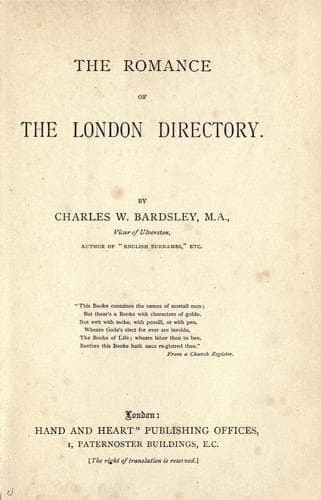
The Romance of the London DirectoryBardsley, Charles Wareing Endell
History
The Romance of the London Directory
Bardsley, Charles Wareing Endell
Names, English -- England -- London; Names, Personal -- England -- London
I dare not say what a large proportion of names in the London Directory
that look like nicknames must be set down as the result of this
old-fashioned custom. The fourteenth century saw London streets looking
as if hung with bannerets, so crowded were they with signs. That was a
period when half of the lower middle class were still without an
hereditary surname. The consequence is, we find such entries as “Hugh
atte Cokke,” or “Thomas atte Ram,” or “Thomas del Hat,” or “Margery de
Styrop.” The reader must see at a glance that we have here the
origination of half our “Cocks” and “Coxes,” “Rams,” “Roebucks,” “Tubbs,”
“Bells,” “Crows.” There are three “Hatts” to forty-one “Heads,” three
“Pates” and two “Crowns” in the London Directory, not to mention three
“Harrows,” two “Plows,” four “Boots,” and ten “Pattens.” All these, and
a hundred other names that appear difficult of origination, are easily
explained when we recall this faded custom of a few centuries ago.
The plan of having numbered doors came into use but very recently. The
signboards were disused in many parts of London before numerals were
instituted. The addresses on letters appeared very strange as a
consequence.
John Byrom, the great epigrammatist, writing to his wife from Cambridge
in 1727, addresses his letter to “Mistress Eliz. Byrom, near the old
Church, in Manchester.” That was the ordinary method, to choose some big
well-known building, and state your friends’ position to it by the
compass. The first Directory ever published, of any pretensions, was
Kent’s, in 1736. “The Directory,” it is called, “sold by Henry Kent, in
Finch Lane, near the Royal Exchange.” It contains about 1200 names, all
the tradesmen and merchants of London. There are such entries as “Samuel
Wilson, hardwareman, in Cannon Street, the corner of Crooked Lane,” or
“John Bradshaw, opposite the Monument, at a barber’s.”
Manifestly this could not go on. In the edition for 1770 occurs the
following: “The Directory . . . with the numbers as they are affixed to
their houses, agreeable to the late Acts of Parliament.” The Legislature
had had to take the matter into hand. London was getting far too big for
indistinct addresses such as these. The first street in the metropolis
to possess numbered doors was New Burlington Street. This was
accomplished in June 1764. Other important throughfares followed suit,
and before ten years had gone by, we find the Directory particularizing
as follows: “John Trelawney, haberdasher, No. 22, Nightingale Lane,” or
“Hamnett Townley, hop merchant, No. 69, Great Tower Street.”
Occasionally a “Vincent Trehearn, hatmaker, behind St. Thomas’s,” comes,
but rarely; and by-and-by such entries disappear altogether. Manchester
began the same practice in 1772, at the request of the borough reeve and
constable, and was the second town in the kingdom to adopt the practice.
Public-domain text, read in full here on John Shaqi.
Reviews
Reviews
No reviews yet
Be the first to share your thoughts on this work.
Join the Discussion
Join the discussion
Sign in to leave a comment or review.
Sign InorCreate an account