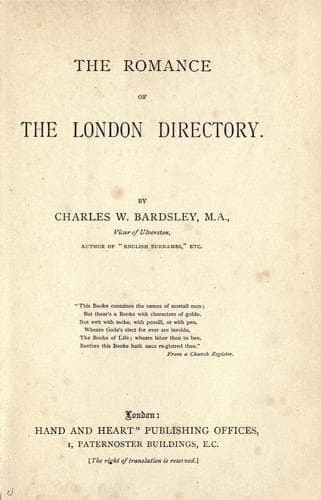
The Romance of the London DirectoryBardsley, Charles Wareing Endell
History
The Romance of the London Directory
Bardsley, Charles Wareing Endell
Names, English -- England -- London; Names, Personal -- England -- London
A lady wrote to me the other day to inform me that I had made a mistake
in ascribing the name “Mason” to the craftsman of that name, for she was
sure she was sprung from Mnason in the Acts of the Apostles, and that the
family had worked its way through Phrygia, and Italy, and Germany, into
England. If she can prove her pedigree, she may boast a genealogy which
the proudest monarch in Europe might envy. The fact is, it is as true of
a hundred reputed foreign names as of the rhyme of the three Devonshire
families, which asserts that
“‘Croker,’ ‘Crewys,’ and ‘Coplestone,’
When the Conqueror came were at home.”
What a pleasant book to look upon would our Directory be if we had all
had the selection of our own surnames! There would have been no
“Pennyfathers.” This was an old English nickname for a miser. An old
couplet says,—
“The liberall doth spend his pelfe,
The pennyfather wastes himself.”
That such a disposition need not be hereditary is proved in the case of
one of the most generous, earnest Christian ministers who ever worked for
Christ in London. Mr. Pennefather is dead; but who would think of
connecting him with the characteristic his name implies? Again, there
would have been no “Piggs,” no “Rakestraws” (an old nickname for a
dust-heap searcher), no “Milksops,” no “Buggs,” no “Rascals.” But the
fact is, the man who had most interest in the matter had least to do with
it. All he could do was to accept his sobriquet, if not with thanks,
with such grace as he could muster. If his children could shuffle it
off, so much the better. Our Directory proves that this was not always
possible. ’Tis true, we have got rid of “Alan Swet-in-bedde’s” _nominal_
descendants, not to mention such cognomens as “Cheese-and-bread,”
“Scutel-mouth” (what a great eater he must have been!) “Red-herring,”
“Drink-dregs,” “Cat’s-nose,” “Pigg’s-flesh,” “Spickfat” (_i.e._
bacon-fat), “Burgulion” (a braggart), and “Rattlebag.” But many of these
names made a hard fight for it, and contrived to hold out till the
seventeenth, or even eighteenth, century. “Piggs-flesh,” I say, is gone;
but “Hog’s-flesh” has been a name familiar to Brighton and its
neighbourhood for six hundred years, and still lives. Charles Lamb’s
little comedy, called “Mr. H.—” (_i.e._, Hog’s-flesh), had for its hero’s
sobriquet no fanciful title. No doubt Mr. Lamb had seen the name in a
Sussex Directory. The story is a relation of Mr. H.’s troubles in polite
society through the attempt to hide his name under the mere initial.
When it is discovered, everybody deserts him. As he quits his hotel, his
landlord says:—
“Hope your honour does not intend to quit the ‘Blue _Boar_.’ Sorry
anything has happened.”
_Mr. H._ (to himself): “He has heard it all.”
_Land._: “Your honour has had some mortification, to be sure, as a
man may say. You have brought your pigs to a fine market.”
_Mr. H._: “Pigs!”
Public-domain text, read in full here on John Shaqi.
Reviews
Reviews
No reviews yet
Be the first to share your thoughts on this work.
Join the Discussion
Join the discussion
Sign in to leave a comment or review.
Sign InorCreate an account