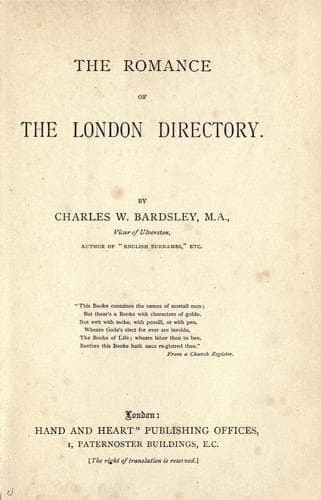
The Romance of the London DirectoryBardsley, Charles Wareing Endell
History
The Romance of the London Directory
Bardsley, Charles Wareing Endell
Names, English -- England -- London; Names, Personal -- England -- London
But while these names can be traced to their true source and meaning, it
is not so with others. Take the following from the London
Directory:—“Six,” “Seven,” “Nine,” “Spon,” “Spitty,” “Kiss,” “Slape,”
“Im,” “Ey,” “Tattoo,” “Tubby,” “Yewd,” “Zox,” “Toop,” “Kitcat,” “Sass,”
“Knags,” “Neeb,” “Siggs,” “Saks,” “Toy,” “Stidd,” “Stap,” and
“Shum,”—what do they mean? Whence came they? Ask the bearers, and they
will say, no doubt, that they came over with William the Conqueror. They
are not the only people who have tried to come William the Conqueror over
us.
In this last list we have mentioned “Kiss.” This reminds me that there
is one instance in the same tome much more demonstrative than
that—namely, “Popkiss”! But there is no difficulty in deciphering this,
as it is a manifest corruption of Popkins, and that of Hopkins. The
Directory teems with examples of the termination _kins_ being turned into
_kiss_ and again into _ks_. Thus we have not merely Perkins, but Perkiss
and Perks—not only Hodgkins, but Hotchkiss—not alone Wilkins, but Wilks;
and so oh with many others.
While some surnames are hopelessly corrupted, and therefore incapable of
interpretation, others are a stumbling-block because they seem so easily
explainable. Such are names like “Coward,” “Craven,” and “Charley.” The
“Coward,” or Cowherd, was a tender of kine; “Craven” is local; and
“Charley” is the same. “Deadman” and “Dedman” are, like “Debnam,” but
corruptions of “Debenham,” and therefore local also. “Tiddyman” looks as
if its first bearer had been tidy in his habits; but it was once a
Christian name, and therefore is a patronymic. “Massinger” has been not
uncommonly explained as Mass-singer. Of course it is the early form of
“Messenger.” “Diamond” is a form of “Dumont,” and “Doggrell” of
“Duckerell”—that is, little duck, a manifest nickname. “Eatwell” and
“Early” are also both of local origin. “Portwine” is first found as
“Poitevin,” the old name for an inhabitant of Poictiers; and “Coleman,”
though apparently connected with the black diamond, is an early baptismal
name. There is a peculiar tendency to skip the natural solution, and go
to the Continent, especially Normandy, for the origin. Thus “Twopenny,”
a palpable relic of the twopenny piece, and twopenny ale, is represented
as hailing from Tupigny in Flanders. “Death” is said to be from D’Aeth
in the same; “Bridges” from Bruges; and “Morley” from Morlaix, where
lived St. Bernard—regardless of the fact that there are a dozen hamlets
styled “Morley” in England; indeed, wherever there is a moorland reach
there is a village or farm styled “Morley.”
Public-domain text, read in full here on John Shaqi.
Reviews
Reviews
No reviews yet
Be the first to share your thoughts on this work.
Join the Discussion
Join the discussion
Sign in to leave a comment or review.
Sign InorCreate an account