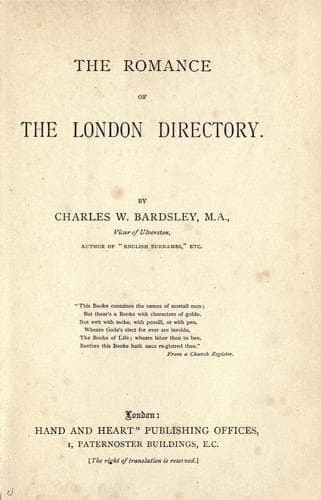
The Romance of the London DirectoryBardsley, Charles Wareing Endell
History
The Romance of the London Directory
Bardsley, Charles Wareing Endell
Names, English -- England -- London; Names, Personal -- England -- London
I have selected this story for a purpose. It explains the origin of
every local surname in existence. A man, in a new community to which he
had joined himself, might go by the name of his occupation, as “Tinker,”
or father’s Christian name, as “Peterson,” or by a nickname from his
social habits, as “Good-fellow”; but in five cases out of ten he bore the
title of the spot whence he issued forth. Take a few instances of the
mode and manner in which these local surnames were formed. All my
illustrations shall be from the London Directory. For perspicuity’s sake
I will separate them into classes.
(_a_) _Local names terminating in_ “_er_” _and_ “_man_.” “Churchman”
would seem to bespeak the original possessor an Episcopalian. But there
was no dissent in the twelfth or thirteenth century. It could give no
individuality as such. It was a local name, implying that John or Peter
Churchman dwelt by the church. Hence also “Churcher.” In the north,
“Church” was pronounced “Kirk.” Therefore, in the north these two names
are found as “Kirkman” and “Kirker,”—exactly as we find “Thacker” in
Yorkshire to be “Thatcher” in Surrey. Of this same class are Crosser and
Crossman, reminding us that there was a time in pre-Reformation days when
every village had its cross, which was as much a landmark as it was an
object of reverence. Bridger and Bridgman lived beside the wooden or
stone structure that spanned the stream.
(_b_) _Some local names still preserve the affix or suffix_
corresponding to the French “del,” “de,” “du,” and “de la,” as Atwood,
Atwater, and Atwell, once William _at the_ wood, or _at the_ water, or
_at the_ well. _By_ is found in Bywater, and Bythesea. Sometimes the
letter “n” got in for euphony’s sake, as in “Nash,” which is sprung from
“atten-ash.” “Thomas atte-n-ash” thus became Thomas Nash. Hence Nolt
for atte-n-holt (_i.e._ wood), or Nalder for “Alder.” Townsend is from
Town’s-end. Thus Peter at the Town’s-end becomes Peter Townsend, or
Townshend. “Tash” is from “at the Ash”; and Thynne, a name belonging to
one of our ennobled families, is said to be from one “John at the Inne.”
(_c_) _Most of these generic names have dropped all suffixes and
affixes_. Here a hundred surnames present themselves to our eye. Who
does not know a Hill or Dale, a Field or Croft? Who has not a friend
called Craig or Cliff, or Dean or Hope? Who has not met with a Grange or
Moor, or Wood or Shaw? Our “Streets” are as thick as Our “Lanes,” and in
the busiest thoroughfares of London you may descry Barnes and Marshes and
Parks and Forests and Warrens without end. The village spring has given
us our “Wells,” the village road our “Crosses,” and the village common
has given us our “Greens.” The following was addressed to a Miss Green
on her fortieth birthday:—
“That evergreen thy graces show;
Some men say ‘Yes,’ and some say ‘No.’
Alas! that one and all agree
That ever-Green thy name shall be!”
Public-domain text, read in full here on John Shaqi.
Reviews
Reviews
No reviews yet
Be the first to share your thoughts on this work.
Join the Discussion
Join the discussion
Sign in to leave a comment or review.
Sign InorCreate an account