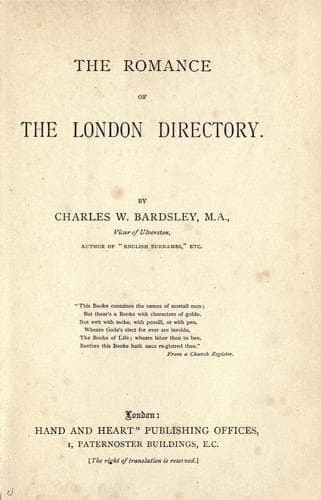
The Romance of the London DirectoryBardsley, Charles Wareing Endell
History
The Romance of the London Directory
Bardsley, Charles Wareing Endell
Names, English -- England -- London; Names, Personal -- England -- London
Greener is common, being formed after the fashion of Knowler and
Knowlman, and Streeter and Streetman, (_vide_ under “_a_”). A Mr.
Greener being devoted admirer of a Miss Green, wrote as follows:—
“One dearest wish I fondly cherish,
My ever-Green so fair, yet lonely:
To make thee mine, and thus thou’lt flourish
Greener, and Greener only.”
To which she responded,—
“I’m Green indeed; but Greener thou,
To think by love declarative,
To make me change charms _positive_
For those at best _comparative_.”
Flood and Fell belong to this same class, except when Flood is Welsh, and
then, like Floyd, it is the same as Lloyd. A Mr. Isaac Fell is said to
have had painted over his shop, in very legible characters, “I. Fell,
from Ludgate Hill”; beneath which, one day, a Shakspearian wag wrote, “O
what a fall was there, my countrymen!” We have mentioned “Dean” above.
In composition it generally appears as “den,” and implies a sheltered and
sunken glade closely surrounded with trees. Hence it was a covert for
cattle and wild beasts, and many of the names we now see bear out the
fact. Not merely do we talk of a “den of lions,” but we descry dens of
“hogs,” “rams,” “oxen,” “kine,” and even “wolves,” in such surnames as
Ogden, Ramsden, Oxenden, Cowden, and Wolvenden. Other compounds of “den”
are not so easily discernible. What Heberden may mean I do not know.
There is still in the Directory one Heberden, a physician. Probably it
was his father, or grandfather, one of three great London doctors in
George the Third’s reign, of whom the _sixain_ got abroad:—
“You should send, if aught should ail ye,
For Willis, Heberden, or Baillie:
All exceeding skilful men,
Baillie, Willis, Heberden:
Uncertain which most sure to kill is,
Baillie, Heberden, or Willis.”
But Moore or “More,” or “Moor,” represented until late in London by
George Moore, whose like we do not expect to see soon again, has been a
butt for the shafts of wit for generations. We could fill the remaining
pages of this chapter with “torts and retorts” upon this sobriquet.
Lorenzo, in the _Merchant of Venice_, says, “It is much that the Moor
should be more than reason; but if she be less than an honest woman, she
is indeed more than I took her for;” to which Launcelot replies irately,
“How every fool can play upon the word!” But some of these epigrams are
not fools’ work, nevertheless. When Sir Thomas More was Chancellor, his
untiring devotion to his office brought a conclusion to all the Chancery
cases in litigation. The following got abroad:—
“When More some years had Chancellor been,
No more suits did remain;
The same shall never more be seen,
Till More be there again.”
When Dr. Manners-Sutton succeeded Archbishop Moore, this rhyme appeared:—
Public-domain text, read in full here on John Shaqi.
Reviews
Reviews
No reviews yet
Be the first to share your thoughts on this work.
Join the Discussion
Join the discussion
Sign in to leave a comment or review.
Sign InorCreate an account