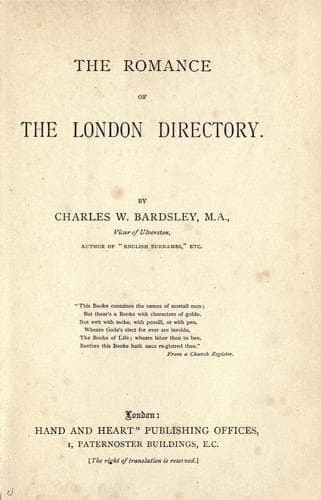
The Romance of the London DirectoryBardsley, Charles Wareing Endell
History
The Romance of the London Directory
Bardsley, Charles Wareing Endell
Names, English -- England -- London; Names, Personal -- England -- London
He and his companions lived by spoil. His popularity was twofold in
origin. He was credited with a spirit of liberty chafing against an
oppressive and tyrannic rule. He was equally credited, truly or the
reverse, with unbounded kindness to the poor. Camden styles him
“_prædonem mitissimum_,” the gentlest of thieves. Sir Walter Scott says
of the spoil he heaped up, that he “shook the superflux to the poor,”
and, in respect of government, “showed the heavens more just.” Dying
about the year 1247, it was not very long before he became an
“institution”: every country ballad, every chapbook had its story of
Robin Hood, his princely spirit, his skill in archery, his wondrous
adventures, and his hair-breadth escapes. The impression that he was of
noble birth only added to his popularity.
This of course could not but have its effect upon the nomenclature of the
time. It is well known that when Thomas à Beckett was murdered, almost
every child born immediately afterwards was, if a boy, christened Thomas.
To this tragedy myriads of Thompsons and Tomlinsons owe their surnames.
The dictionary and the directory are under equal obligations to Robin
Hood. There need be little doubt that Gough’s suggestion that his real
name was “Robin o’ the Wood” (_i.e._ Sherwood) is true. The corruption
“Hood” is perfectly natural.
(1.) Look at some of our _place-names_. In 1730 there was a “Robin
Hood’s Well,” about three miles north of Doncaster; and Leland, the great
itinerary, visited “Robyn Hudd’s Bay,” under which antique dress we
recognise the familiar village and coast “Robin Hood’s Bay,” betwixt
Whitby and Scarborough. Everybody has seen a Robin Hood’s oak, or a
Robin Hood’s bower. At this moment there are hundreds of country inns in
the north, called “Robin Hood,” with a picture of the bold archer in
dress proper, or intended to be so, to the period in which he is supposed
to have lived. His bow and arrow are of course always depicted, and
occasionally a deer in the distance.
(2.) Look at the old English _proverbs_; and we may premise that if a
man has created a proverb he has made himself immortal. “Good even,
Robin Hood,” quoted by Skelton, poet-laureate to Henry VIII., implied
“civility extorted by fear.” Fuller quotes, “Many men talk of Robin Hood
that neere shott in his bow.” “To over-shoot Robin Hood,” is another
proverbial saying. This is quoted by Sir Philip Sidney. “Tales of Robin
Hood are good for fools,” is quoted by Camden. The most familiar,
however, was “to sell Robin Hood’s pennyworths.” Fuller refers to this
as of things half sold, half given; the great robber parting lightly with
what he came by lightly. “Robin’s choice,” this or nothing, would seem
almost to have suggested “Hobson’s choice,” for Hobson is a patronymic of
Robert, Hob being the old familiar pet name for the same.
Public-domain text, read in full here on John Shaqi.
Reviews
Reviews
No reviews yet
Be the first to share your thoughts on this work.
Join the Discussion
Join the discussion
Sign in to leave a comment or review.
Sign InorCreate an account