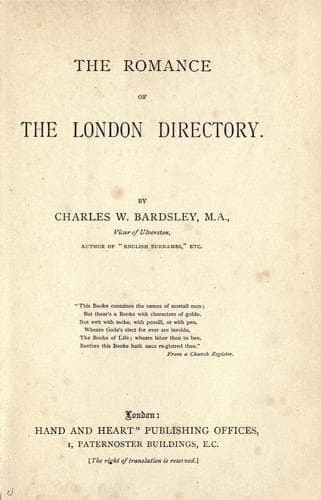
The Romance of the London DirectoryBardsley, Charles Wareing Endell
History
The Romance of the London Directory
Bardsley, Charles Wareing Endell
Names, English -- England -- London; Names, Personal -- England -- London
(3.) To Robin Hood, again, we doubtless owe the familiarity of several
names applied to the _spirit world_. Our forefathers were very
superstitious, especially the country peasantry. A belief in “brownies,”
“dobbies,” “pixies,” and elves kindly or mischievous, still largely
prevails in places removed from the busy towns. Superstitions of this
kind die where men are herded together. It is only in dusky woodlands
ghostly sights appear, or in the silences of the rural churchyard or
forest avenue that voices are heard whose utterance is not from human
throat! Certainly Robin Hood must stand sponsor for much of the dread
that nurses infused into naughty children’s breasts. The pet names or
nurses’ names of Robert were “Robin,” “Hob,” and “Dob.” The _ignis
fatuus_, to this day an object of apprehension, was associated early with
the bold freebooter:—
“Some call him _Robin Goodfellow_,
_Hob-goblin_, or mad Crisp.
And some againe doe terme him oft,
By name of Will the Wispe.”
So says an old ballad. _Robin_ Goodfellow and _Hob_-goblin, it will be
seen, represent the same name. Another title for the same was
“Hob-lanthorn” (_i.e._ Robin’s lanthorn). Dr. Halliwell gives the term
“Hob-thrush,” adding that it is always used in association with Robin
Goodfellow. In the “Two Lancashire Lovers” (1640) it is said, “If he be
no hob-thrush, nor no Robin Goodfellow, I could finde with all my heart
to sip up a sillybub with him.” Here, then, are four names, “Robin
Goodfellow,” “Hob-goblin,” “Hob-lanthorn,” “Hob-thrush;” all used to give
personation to that curious light which occasionally may be seen in
marshy and woody districts. How natural that these should be associated
with that mysterious denizen of the forest, whose name was in everybody’s
mouth, and who came and went, who showed himself here, there, and
everywhere, and yet could never be caught!
“From elves, _hobs_, and fairies,
Defend us, good Heaven,”
say Beaumont and Fletcher in one of their plays. And every reader of
Shakespear will remember how in “A Midsummer Night’s Dream” the Fairy
addresses Puck as—
“That shrewd and knavish sprite
Called Robin Goodfellow:”
while by-and-by she adds:—
“Those that Hob-goblin call you, and sweet Puck,
You do their worst, and they shall have good luck.”
In the extreme north of England the pet name for Robert was Dob, or
“Dobbin.” Curiously enough, to this day the term for Hob-goblin is there
“Dobby.” {63} I ask the reader, if this can be an accident? Could it
have been possible that five distinct names should be given to the _ignis
fatuus_, or to such woodland elves as were supposed to reveal themselves
under his frolicsome light, all having Robert as their chief component,
had not the thousand and one stories about Robin Hood and his merry men
and their nightly escapades been spread over the land by the
ballad-mongers of the time that immediately followed his death?
Public-domain text, read in full here on John Shaqi.
Reviews
Reviews
No reviews yet
Be the first to share your thoughts on this work.
Join the Discussion
Join the discussion
Sign in to leave a comment or review.
Sign InorCreate an account