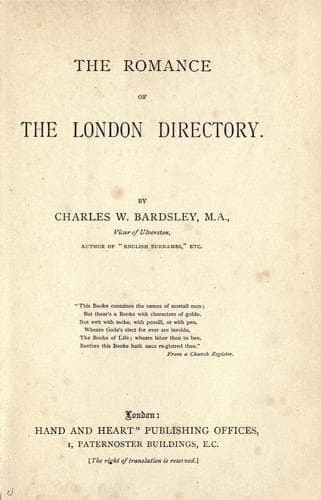
The Romance of the London DirectoryBardsley, Charles Wareing Endell
History
The Romance of the London Directory
Bardsley, Charles Wareing Endell
Names, English -- England -- London; Names, Personal -- England -- London
But an equally grave crisis in English nomenclature was the publication
of an English Bible, and the Reformation of Religion that followed. From
that day all our common and familiar Bible names came into use. Till
then the only Scripture names in vogue were those set down in the
Calendar of the Saints, or such names as were employed in the
“Mysteries,” or “Plays” taken from Scripture stories, performed at
festivals for the amusement and instruction of the peasantry and
tradespeople. From the day of the Reformation the _out-of-the-way_
sobriquets of the Bible came into favour. As these increased, what we
may call the pagan names decreased. The popularity of Harry, Dick,
Robert, and Walter began to fade. Some, like Hamond, Avice, Drew, Payn,
and Warin, altogether disappeared, while Guy, Baldwin, and Edward held
but a most precarious existence.
Here then are two epochs—the Norman, and the Puritan. Let us confine
ourselves in this chapter to the first.
“_Pagan_” and “_Christian_” were both favourite baptismal names in the
Norman epoch. The former was registered as “Payn” or “Paine.” Chaucer
says,—
“The constable and Dame Hermigold, his wife,
Were payens, and that country everywhere.”
All our “Pagans,” “Payns,” “Paines,” and “Pinsons” are from this
old-fashioned sobriquet. A century ago, the Hon. Thomas Erskine having
been seized with a serious illness, and kindly tended at Lady Payne’s
house in London, wrote,—
“’Tis true I am ill; but I need not complain,
For he never knew pleasure who never knew Payne.”
_Christian_ has never been popular in England, but Christopher has; and
besides the long “Christophers” and “Christopherson,” has left us Kitts
and Kitson.
Another name, a Scripture name too, is now all but wholly disused—that of
Samson. I daresay many of my readers have thought that our many Sampsons
are all but entirely descended from Sam-son, _i.e._, the son of Samuel.
I have no hesitation in claiming a full half for the son of Manoah, the
Danite. The old registers teem with entries like “Samson de Battisford”
or “Sampson Dernebrough.” Shallow says (2 _Hen. IV._), “And the very
same day did I fight with one Sampson Stockfish, a fruiterer behind
Gray’s Inn.”
“I am not Samson, nor Sir Guy, nor Colbrand,
To mow ’em down before me,”
says the porter’s assistant in _Henry VIII_. The fact is, the story of
Samson was a favourite one with our forefathers, and often performed at
the miracle-plays. There are nearly fifty Sampsons and Samsons in the
London Directory, some of them being of purely Jewish descent. “Elegant
Extracts,” a favourite storehouse of good, bad, and indifferent (very)
poetry for the youth of our country in the last century, has the
following, anent this name:—
“Jack, eating rotten cheese, did say,
‘Like Samson, I my thousands slay.’
‘I vow,’ quoth Roger, ‘so you do,
And with the self-same weapon too.’”
Public-domain text, read in full here on John Shaqi.
Reviews
Reviews
No reviews yet
Be the first to share your thoughts on this work.
Join the Discussion
Join the discussion
Sign in to leave a comment or review.
Sign InorCreate an account