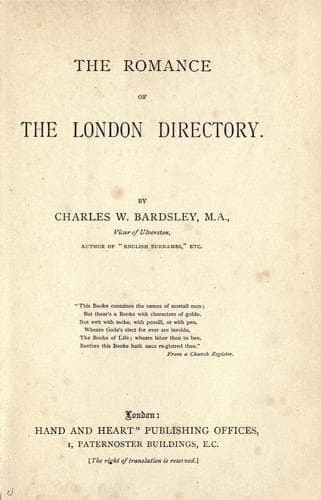
The Romance of the London DirectoryBardsley, Charles Wareing Endell
History
The Romance of the London Directory
Bardsley, Charles Wareing Endell
Names, English -- England -- London; Names, Personal -- England -- London
(_e_) _Hob_ has transmitted Hobb, Hobbs, Hobbes, Hobbiss, Hobson,
Hobbins, Hoblyn, Hopkins, Hopkinson, Hopps, and Hopson.
(_f_) Besides these there were once such familiar French diminutives as
Robinet, Dobinet, Robelôt, and Robertôt. These did not come directly
from France or Normandy. They were forms adopted by the country people
from the habit, common then as now, of copying the fashions of the more
noble families. Elizabeth Robinett will be found in the London
Directory. Hers is the only instance that I can find still existing.
The rest were all surnames in the fourteenth century. {66}
(_g_) The Welsh, seizing upon the name, turned ap-Robert and ap-Robyn
into Probert and Probyn, respectively.
Can I add anything to prove the popularity of Robin Hood? It is possible
that we could not have spoken of Hobbism, or of a Hobbist, for the
founder of that system of philosophy might have borne some other name.
It is possible that there might have been no “Hobson’s choice,” for that
worthy liveryman at Cambridge might, under some other sobriquet, have
compelled the young collegian to take the next horse on the list, or
none. Certainly our old friend _Punch_ would have been unable to poke
fun at Cockneydom under at least one name of the famous company of
“Brown, Jones, Smith, and _Robinson_.” It is possible, too, that “before
you could say Jack Robinson” would never have become an English
commonplace. How the phrase originated I cannot say, but it is a very
old one, if the couplet quoted from an old play by Dr. Halliwell be
genuine:—
“A warke it ys as easie to be doone,
As tys to saye ‘Jacke Robyson.’”
CHAPTER V.
EARLY PET NAMES.
THE present and following chapter I purpose devoting to the further
consideration of the subject of baptismal names. There are distinct
epochs in the history of names, as in the history of everything else.
One great crisis in our national nomenclature was the Norman Conquest.
With the exception of Alfred, Arthur, Edwin, Edward, Ethel, and say a
dozen other agnomens which were preserved through various accidents, all
English names of the pre-Norman period disappeared before the end of the
twelfth century. They were literally submerged beneath the advancing
tide of Norman titles and usages. All the great popular sobriquets so
familiar to us to-day, such as William, Henry, Ralph, Richard, Gerald,
Robert, and even Scripture and Saint’s-day names like John, Ellis
(Elias), Stephen, and Matthew, belong to the later epoch.
Public-domain text, read in full here on John Shaqi.
Reviews
Reviews
No reviews yet
Be the first to share your thoughts on this work.
Join the Discussion
Join the discussion
Sign in to leave a comment or review.
Sign InorCreate an account