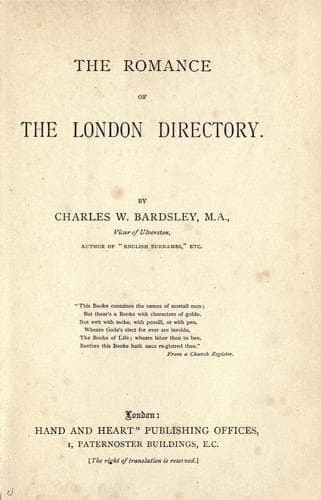
The Romance of the London DirectoryBardsley, Charles Wareing Endell
History
The Romance of the London Directory
Bardsley, Charles Wareing Endell
Names, English -- England -- London; Names, Personal -- England -- London
Our Waters and Watersons are thus explained. _Antony_ has bequeathed us
Tonkin, Tonson, and Tounson; _Philip_, Phipps, Phillips, and Philpotts
(_i.e._ Philipot, that is, little Philip, a pet name). A curious form of
Philpot may be seen in the Directory in the shape of Fillpot. This
reminds us that many a play has been made on the name. It was not so
very long ago that Punch facetiously remarked upon the fact that the
newly elected Bishop of Worcester was Philpott, the then Bishop of Exeter
being the celebrated Philpotts,—
“‘A good appointment? No, it’s not,’
Said old beer-drinking Peter Watts;
‘At Worcester one but hears “Philpott,”
At generous Exeter “Philpotts.”’”
A large number of patronymics are to be seen in the surnames that come
under the division “N” in the Directory. In the old song “Joan to the
Maypole” it is said,—
“Nan, Noll, Kate, Moll,
Brave lasses, have lads to attend ’em:
Hodge, Nick, Tom, Dick,
Brave country dancers, who can amend ’em?”
“Nan” stands for Anna or Hannah, Noll for Olive or Oliver, in this case
Olive, a girl’s name. In fact, every name that began with a vowel was
turned into a pet form beginning with “N.” Edward became Ned, and Emma
Nem. Thus in St. Peter’s, Cornhill, the register says,—
“Sept. 20, 1577. Fryday, buryed, Nem Carye, daughter of Harry
Carye.”
Humphrey became Nump, and Abel, Nāb. In Ben Jonson’s “Alchemist,” the
tobacco man Abel addresses Face,—
“Yes, sir; I have another thing I would impart,”
to which Face replies,—
“Out with it, Nāb.”
Again, Isabella became Nib. The result of this is, that such surnames as
Nibbs, Nabbs, and Nemms or Neams, are common. Even Nance, which figures
twice in the Postal Directory, is just as likely to be the old “Nans,”
from Anna, as from the town of Nantes. The owner can take his choice,
however, and probably will prefer the local origin.
Talking of girls’ names, we may notice how many surnames owe their origin
to Matilda, Emma, Isabella, and Petronilla. There are pages of
Tillotsons, Tillots, Tilletts, Tilts, and Tills, all from the old pet
form Till. Emma, too, is commemorated in little companies of Emms, Emps,
Emsons, Empsons, Emmotts, Emmetts, and Emmotsons; while Isabella is not
far behind with the retinue of Ibbs, Nibbs, Ibbotts, Ibbetts, and
Ibbotsons. Petronilla, the feminine form of Peter, was always known as
Parnel, and is thus found in St. Peter’s, Cornhill:—
“1586, Aprill 17. Sonday, christening of Parnell, daughter of
William Averell, merchaunt tailor.”
Hence our many Parnells and Parnalls. Mary has left us Mollison and
Marriott (_i.e._ little Mary), but was never popular in England during
the days of surname formation. Maria was practically unknown till the
seventeenth century. As Charles Lamb says,—
Public-domain text, read in full here on John Shaqi.
Reviews
Reviews
No reviews yet
Be the first to share your thoughts on this work.
Join the Discussion
Join the discussion
Sign in to leave a comment or review.
Sign InorCreate an account