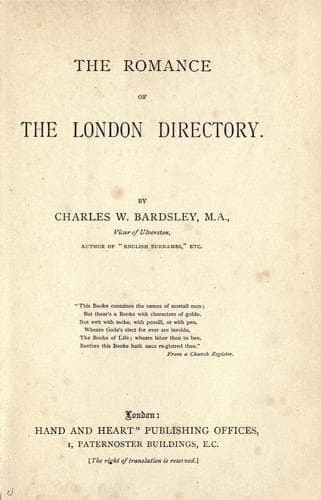
The Romance of the London DirectoryBardsley, Charles Wareing Endell
History
The Romance of the London Directory
Bardsley, Charles Wareing Endell
Names, English -- England -- London; Names, Personal -- England -- London
“_Maria_ asks a statelier pace,—
‘Ave, Maria, full of grace!’
Romish rites before me rise,
Image worship, sacrifice,
And well-meant but mistaken pieties.”
It is a proof that even in days long anterior to the Reformation the
English peasantry had an inrooted objection to a foreign religious yoke,
in the shape of Popery, that such names as Peter and Mary should be so
scantily represented. ’Tis true that Peter has left his mark upon the
Directory. There are shoals of Peters, Petersons, Perkins, Pearces,
Piers, Pierces, and Pearsons, but their origin belongs to an earlier day.
Certain it is, that at least a century before the reign of Mary, the name
was growing into disrepute with the English people, and no doubt the
obnoxious tax of Peter’s-pence was at the root of it.
_Guy_ was turned in Norman nurseries into Guiot (_i.e._, little Guy);
this in English was transformed into Wyatt. How popular this name was
four hundred years ago, is proved by the fact that there are nearly sixty
Wyatts set down in the London Directory alone. William, Walter, Warin,
and Wyatt all testify to the change of French G into English W. In the
French Directories they will still be found as Guillaume, Gualter,
Guarin, and Guiot. And as Guillaume became William, so Guillemot (little
William) became Williamot, and then Wilmot. The French, however, unlike
the English, were very fond of adding _two_ diminutives to the name.
Thus, Guillot (little Will) became Guillotin (little wee Will). This
reminds us of Dr. Guillotin, who invented that terrible instrument which
played such a horrible part in the French Revolution. In the same way,
Hugh (always spelt “Hew” in mediæval records) became English Hewet
(little Hugh), and French Hugot. But our neighbours, inserting another
diminutive, turned it into Hugenot (little wee Hugh). This at once
explains a matter of much contention. There has been much strife as to
the origin of the word Huguenot. Had our friends only been aware of the
fondness of the French some centuries ago for _double diminutives_, they
would have seen at once that the sect sprang from some _individual_
bearing that name, the origin of which is perfectly simple. It may be of
interest to add, that we in England have never used _double diminutives_.
In France it was the rule rather than the exception, as their Directories
fully prove. Introduced by the Normans, we have both “in” and “ot” or
“et,” as in “Col_in_” and “Hew_et_,” from Nicholas and Hugh; but we never
conjoin them to one name. A Frenchman four hundred years ago would have
turned them into “Col-in-et,” “Col-ot-in,” “Hugu-in-ot,” or “Hug-ot-in.”
’Tis true, we in England called children “Rob-in-et,” as I have shown in
a previous chapter; but it was a mere passing fancy. I was wrong,
however, in stating that the surname “Robinet” is practically obsolete,
for Mr. Hutton, the Rector of Stilton, writes to inform me that in a
Public-domain text, read in full here on John Shaqi.
Reviews
Reviews
No reviews yet
Be the first to share your thoughts on this work.
Join the Discussion
Join the discussion
Sign in to leave a comment or review.
Sign InorCreate an account