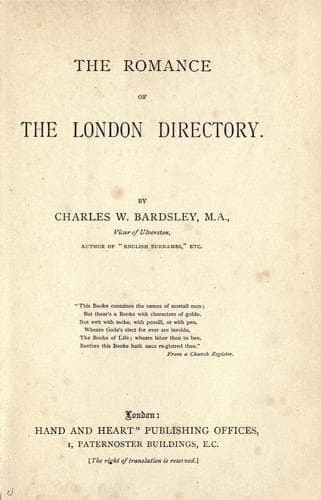
The Romance of the London DirectoryBardsley, Charles Wareing Endell
History
The Romance of the London Directory
Bardsley, Charles Wareing Endell
Names, English -- England -- London; Names, Personal -- England -- London
Miss Yonge thinks that Margaret Atheling introduced Alexander into
Scotland from the Hungarian Court. Her third son was Alexander, and
under him and the other two Alexanders Scotia was prosperous. Hence its
great popularity. Sawney and Sandy are the pet forms, and the surnames
Alister, McAlister in the Highlands, and Sanders or Saunders in the
Lowlands, will for ever prevent the name being forgotten.
Patrick, the patron saint of Irishmen, whose festival is kept wherever
Irishmen may be, has, strange to say, left scarcely a single surname.
There is “Kil-patrick,” and “Gos-patrick”—_i.e._, servant of Patrick (Gos
= gossoon, _i.e._ garçon), but no real patronymic. How is this? One
single reason will suffice. At the time of surname formation “Patrick”
was scarcely ever used at the font. “Teague” was the popular name till
the end of the seventeenth century. Under 150 years ago, Englishmen
spoke of an Irishman, not as “Pat,” but as “Teague.” I could prove this
equally from registers and ballads.
“Taffy,” of course, was and is the Welsh national name, and owes his
origin to St. David, who lived in the sixth century, and through his
sanctity caused his bishop’s see to be changed from Menevia into St.
David’s. Davy, Davis, and Davies are therefore common enough in the
Principality. From our childhood we have heard that—
“Taffy was a Welshman,
Taffy was a thief;”
but we trust, for the credit of our friends across the Severn, that this
refers to a particular Taffy, and not to the national Taffy. Black sheep
are to be found in every flock. That Taffy can be a hero, Happy Dodd and
his compatriots can prove; and never was the Albert Medal more richly
deserved or more bravely won, than on the morning that witnessed the
rescue of the imprisoned miners in the Welsh coal-pit. All honour to
Taffy!
CHAPTER VI.
THE BIBLE AND NOMENCLATURE.
I SAID in my last chapter that I should devote the present one to a
relation of the causes that led to a complete revolution in our English
baptismal nomenclature in the sixteenth and seventeenth centuries.
During this comparatively brief period, most of the popular mediæval
names lapsed, not merely from favour, but into total oblivion. ’Tis
true, this does not properly appertain to the subject of surnames,
because, having now become an established system, it was impossible for
the Reformation to affect them to any appreciable extent. That is, the
Reformation could revolutionize our baptismal names, but not our
surnames. Had the Reformation occurred three or even two centuries
earlier, the London Directory of 1877 would have presented a totally
different appearance to that which it does. Instead of half a thousand
Harrisons and Harrises, we should have had, may be, a hundred
“Calebsons,” and “Abnersons,” and “Joshuasons,” and “Jaelsons.” Why?
Because surnames were undergoing their hereditary formation then.
Public-domain text, read in full here on John Shaqi.
Reviews
Reviews
No reviews yet
Be the first to share your thoughts on this work.
Join the Discussion
Join the discussion
Sign in to leave a comment or review.
Sign InorCreate an account