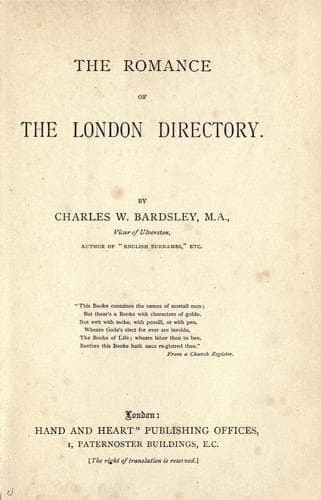
The Romance of the London DirectoryBardsley, Charles Wareing Endell
History
The Romance of the London Directory
Bardsley, Charles Wareing Endell
Names, English -- England -- London; Names, Personal -- England -- London
(1) _Individualization_. The word _sur_name means an _added_
name—_i.e._, a sobriquet added to the personal or baptismal name. Why?
Because one was not sufficient to give individuality to the bearer. Adam
and Eve, and Seth, and Abel, and Joseph, and Moses, all were enough while
population was small; but manifestly such simplicity could not last. In
the wilderness there were, say, 2,500,000 Israelites. How could one
suffice there, especially if “Caleb” or “Joshua” had become so popular
that there were, say, 50 or 100 of each in the closely-packed community?
It was not enough: therefore we find a surname adopted, that is, an added
name. “Joshua, the son of Nun”—“Caleb, the son of Jephunneh”—are amongst
the world’s first surnames. In Directory language this is simply “Joshua
Nunson,” or “Caleb Jephunneh.” Simon Barjonas is nothing more than Simon
Johnson. Remember, however, these were not _hereditary_. They died with
their owner, and the child, if there was one, got a surname of his own.
Surnames did not become hereditary in Europe even till the beginning of
the twelfth century, and among the lower classes not till the fourteenth
and fifteenth centuries.
Imagine London with, say, 3,000,000 souls, each possessing but one name.
Picture to yourself to-morrow’s post bringing 1000 letters to “Mr. John,”
or “John, Esquire.” We can’t conceive it. No, a surname became an
imperative necessity when population increased, when men herded together,
and communities began to be formed. It is curious to note that some of
these surnames have become so common that they have failed of their
object, and ceased to give individuality. There are 270,000 “Smiths” in
England and Wales, and as many “Joneses.” They would together form a
town as large as Manchester, or separately as big as Leeds. William
Smith scarcely individualizes the bearer now; so he either gets three
names or four names at the font, or his identity is eked out by a
remarkable single name, perchance “Plantagenet,” or “Kerenhappuck,” or
“Napoleon,” or “Sidney.” The worst of it is that “Sidney” was so
greedily fixed upon after it became famous that there are now hundreds of
“Sidney Smiths,” and thus it has ceased to give proper individuality. It
is the same with “John Jones.” The Registrar-General says that if “John
Jones” were called out at a market in Wales, either everybody would come,
or nobody: either everybody, thinking that you meant each, or nobody,
because you had not added some description which should distinguish the
particular John Jones you wanted. I remember at college two John Joneses
went in for examination for the “little go.” Both belonged to the same
college; one passed, the other did not. The one who got first to the
schools bore away his certificate in triumph. The one who came last
always declared that his _confrère_ had robbed him of his “testamur,” and
I have no doubt will die assured of the same! I believe a day will come
Public-domain text, read in full here on John Shaqi.
Reviews
Reviews
No reviews yet
Be the first to share your thoughts on this work.
Join the Discussion
Join the discussion
Sign in to leave a comment or review.
Sign InorCreate an account