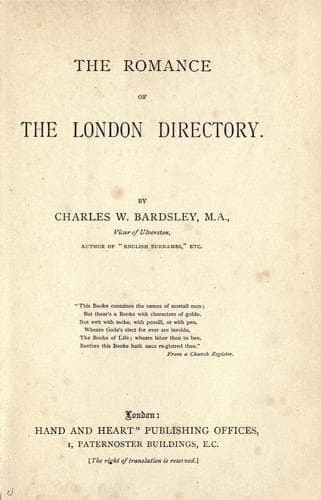
The Romance of the London DirectoryBardsley, Charles Wareing Endell
History
The Romance of the London Directory
Bardsley, Charles Wareing Endell
Names, English -- England -- London; Names, Personal -- England -- London
when, either by compulsory enactment or by voluntary arrangement, there
will be a redistribution of surnames in Wales; the sooner the better.
(2) _Localization_. So much for the personality; now for locality. It
is one thing to know the name of the man you want; it is another thing to
know where you can find him. In a word, where does he live? “Go into
the street which is called Straight, and enquire in the house of Judas
for one called Saul, of Tarsus,” says the Divine Book. This would not be
enough in the nineteenth century. There are streets a mile long now.
There are restaurants above the shops, and offices above the restaurants,
and the old woman who cleans the building above them all. How is Mrs.
Betsy Pipps to be found of her friends? Yet a letter from her daughter
in the country about the cows and the turnips has as much right to find
its way to that top room in the murky city as a posted document about
Turkey and Russia to Lord Derby in that big place a little further on.
One of the greatest transformations the streets of London ever saw was
when the signboards were taken down. These were at first adopted purely
to localize the inhabitant of the house pendent from whose wall the
signboard swung. Until the reign of Queen Anne, the streets could
scarcely be seen further than a few yards because of these innumerable
obstructions. They darkened the streets, obscured the view, and
threatened the very lives of the horsemen who rode along. The personal
discomfort to wayfarers was great, for not only did the rain drip
unpleasantly from them, but the wooden spouts, which frequently shot
forward from the roof in order that the signboard might swing from them,
poured their little cataracts upon the devoted heads of the passers-by.
This infliction was patiently endured for several centuries; but the
British ratepayer at last made his voice heard, as in the end he always
does. This time, too, he had right on his side, as he invariably thinks
he has, and an alteration took place. The ruling powers ordered the
obnoxious signs to be placed flat against the walls. The idea of
removing them entirely was reserved for a more brilliant intellect a few
years later on. I have not yet seen the printed regulation for the
metropolis, but no doubt the Manchester document was but a copy of it.
The declaration issued for that town runs as follows: “With the
approbation and concurrence of the magistrates, we, the borough reeve and
constables, request the shopkeepers and innholders of this town, who have
not already taken down their signs, to do the same as soon as possible,
and place them against the walls of their houses, as they have been long
and justly complained of as nuisances. They obstruct the free passage of
the air, annoy the passengers in wet weather, darken the streets,
etc.,—all which inconvenience will be prevented by a compliance with our
request, and be manifestly productive both of elegance and utility.”
Public-domain text, read in full here on John Shaqi.
Reviews
Reviews
No reviews yet
Be the first to share your thoughts on this work.
Join the Discussion
Join the discussion
Sign in to leave a comment or review.
Sign InorCreate an account