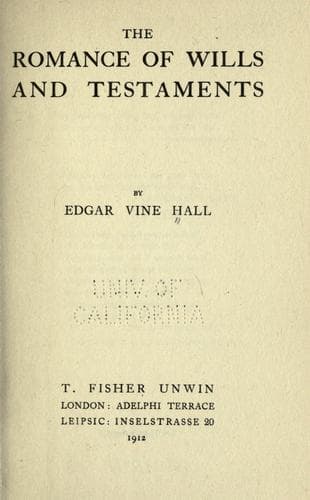
The Romance of Wills and TestamentsVine Hall, Edgar
History
The Romance of Wills and Testaments
Vine Hall, Edgar
Wills -- Great Britain -- Miscellanea
In days to come, perhaps, peculiar interest will attach to the will
of Mlle. Meunier, the Frenchwoman who sympathised with the views of
Ferrer and left him a considerable legacy some ten years before his
execution. But who can estimate the value of Raisley Calvert’s legacy
to Wordsworth, whereby the poet was relieved of the deadening care of
money-making?
“A youth—(he bore
The name of Calvert—it shall live, if words
Of mine can give it life,) in firm belief
That by endowments not from me withheld
Good might me furthered—in his last decay
By a bequest sufficient for my needs
Enabled me to pause for choice, and walk
At large and unrestrained, nor damped too soon
By mortal cares. Himself no Poet, yet
Far less a common follower of the world,
He deemed that my pursuits and labours lay
Apart from all that leads to wealth, or even
A necessary maintenance insures,
Without some hazard to the finer sense;
He cleared a passage for me, and the stream
Flowed in the bent of Nature.”
Changes and controversies in the Church find an echo in wills. Dr.
Sanderson, Bishop of Lincoln, whose will was made about three weeks
before his death (January 29, 1662-3) professes his faith at a
significant date: “And here I do profess that as I have lived so I
desire and—by the grace of God—resolve, to die in the communion of the
Catholic Church of Christ, and a true son of the Church of England:
which, as it stands by law established, to be both in doctrine and
worship agreeable to the word of God, and in the most material points
of both conformable to the faith and practice of the godly Churches of
Christ in the primitive and purer times, I do firmly believe: led so
to do, not so much from the force of custom and education—to which the
greatest part of mankind owe their particular different persuasions
in point of Religion,—as upon the clear evidence of truth and reason,
after a serious and impartial examination of the grounds, as well of
Popery as Puritanism, according to that measure of understanding,
and those opportunities which God hath afforded me: and herein I am
abundantly satisfied that the schism which the Papists on the one
hand, and the superstitions which the Puritans on the other, lay to
our charge, are very justly chargeable upon themselves respectively.
Wherefore I humbly beseech Almighty God, the Father of mercies, to
preserve the Church by His power and providence, in peace, truth, and
godliness, evermore to the world’s end: which doubtless He will do,
if the wickedness and security of a sinful people—and particularly
the sins that are so rife, and seem daily to increase among us, of
unthankfulness, riot and sacrilege—do not tempt His patience to the
contrary. And I also further humbly beseech Him, that it would please
Him to give unto our gracious Sovereign, the reverend Bishops, and the
Parliament, timely to consider the great danger that visibly threatens
Public-domain text, read in full here on John Shaqi.
Reviews
Reviews
No reviews yet
Be the first to share your thoughts on this work.
Join the Discussion
Join the discussion
Sign in to leave a comment or review.
Sign InorCreate an account