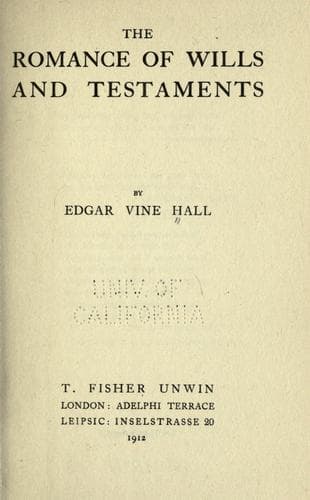
The Romance of Wills and TestamentsVine Hall, Edgar
History
The Romance of Wills and Testaments
Vine Hall, Edgar
Wills -- Great Britain -- Miscellanea
this Church in point of religion by the late great increase of Popery,
and in point of revenue by sacrilegious inclosures; and to provide such
wholesome and effectual remedies, as may prevent the same before it be
too late.”
Similarly, Richard Ward, whose will is dated February 6, 1664-5,
bequeaths his “body to the earth whence it was taken, to be decently
and Christianly buried according to the order of the Church of England
... wishing and praying from my very soul that this sinful and
unthankful kingdom may never forget or forfeit that most miraculous
mercy of God in restoring and establishing it.” Such contemporary
comments are fascinating; so, too, the spirit of the same testator who
dedicates his “young tender and only son George Ward” to the service
of the Church, “if God shall so dispose his heart, which I trust He
will because I am not without hopes that God Almighty did accept of my
solemn dedication of him before he was formed in the womb. And the good
God be his guide and portion.” It is not surprising to find this gentle
spirit “languishing under the fatherly visitation of my most gracious
God, to whose good pleasure I with all cheerfulness submit,” and
speaking of his “dear sweet wife” and “dear and tenderly loving wife.”
The Restoration is a landmark in history. But there are passages in
wills which recall the clash of controversialists forgotten now, yet
provocative of fierce animosities in their time. Edward Evanson, who
became Rector of Tewkesbury in 1769, was a modernist and innovator,
a Richard Meynell of his day. In reading the services he would adapt
words or phrases at pleasure, and in the lessons point out errors of
translation. But a crisis was provoked by a sermon on the Resurrection
preached at Easter, 1771. He was prosecuted in the Consistory Court
of Gloucester, for “depraving the public worship of God contained
in the liturgy of the Church of England, asserting the same to be
superstitious and unchristian, preaching, writing, and conversing
against the creeds and the divinity of our Saviour, and assuming to
himself the power of making arbitrary alterations in his performance
of the public worship.” Finally the charge fell through, on technical
grounds, in 1777, but Mr. N. Havard, town clerk of Tewkesbury,
published a narrative of the case. After a life of controversy Evanson
died on September 25, 1805.
We can trace out bequests both for and against this troubler of the
peace. Penelope Taylor, of Worcester, a widow with views beyond the
circle of her home, gave by a codicil dated July 5, 1776, to Mr. Havard
£200 to testify her approbation of his conduct “in the prosecution
against Mr. Evanson, Vicar of Tewkesbury, and toward the expense of
that laudable suit in the defence of Christianity.”
Public-domain text, read in full here on John Shaqi.
Reviews
Reviews
No reviews yet
Be the first to share your thoughts on this work.
Join the Discussion
Join the discussion
Sign in to leave a comment or review.
Sign InorCreate an account