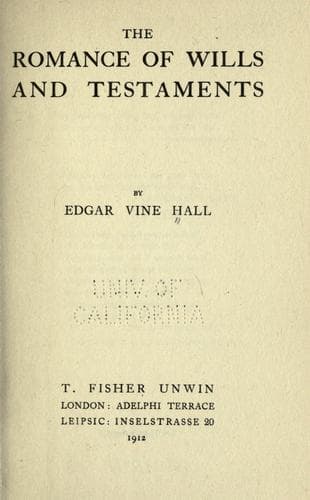
The Romance of Wills and TestamentsVine Hall, Edgar
History
The Romance of Wills and Testaments
Vine Hall, Edgar
Wills -- Great Britain -- Miscellanea
But Dr. Messenger Monsey, with no measured language, in his will
dated twelve years later, upholds the other side. The controversy was
not forgotten. Dr. Monsey was a contemporary of Dr. Johnson, one who
“talked bawdy” in the latter’s less than elegant phrase. His will, in
several respects noteworthy, must appear again. He had given, he says,
by a previous will an annuity of £50 to Mr. Evanson; but since he had
declined it, the testator substituted a nominal gift of £10 per annum,
to manifest his great regard “for my friend Mr. Edward Evanson, and
the opinions I have of his abilities and integrity in standing forth
so ably as he has done in support of reason and true religion against
the nonsense jargon and impiety so avowedly professed by a set of A.
B————ps, D————ns, P————ts, and D————cons, who stood forth in defence of
creeds articles and subscriptions without suffering or promoting any
reformation for establishing the purity and simplicity of reasonable
Christianity.”
Last of all died Evanson. His will is disappointing. It opens thus:
“I Edward Evanson think it my duty under present circumstances to
dispose of that portion of worldly property with which it hath pleased
the divine providence of God to bless me.” Otherwise there is no
reference to religion, none to his stormy life, save this incidental
remark: “Conscientious objections to the Liturgy of the Established
Church having prevented my standing godfather for my brother-in-law
Mr. William Alchorne’s son, which I should otherwise have done, in
lieu of the customary baptismal gifts I now give and bequeath to Mr.
Wm. Alchorne aforesaid the sum of £50 in trust and for the sole use of
his son Evanson Alchorne.” His wife Dorothy was residuary legatee, and
the will, witnessed by three servants, was dated April 8, 1805, and
proved on October 16th. He was a fighter; but not one of those who make
militant wills, proclaiming, as it were with the last breath, their
prepossessions and beliefs.
VI
“When London’s plague, that day by day enrolled
His thousands dead, nor deigned his rage to abate
Till grass was green in silent Bishopsgate,
Had come and passed like thunder—still, ’tis told,
The monster, driven to earth, in hovels old
And haunts obscure, though dormant, lingered late,
Till the dread Fire, one roaring wave of fate,
Rose, and swept clean his last retreat and hold.”
WILLIAM WATSON.
It was to be expected that the plagues would leave their mark on these
records, and very tragic such traces are. Many were driven to make
their wills while still in health, but others delayed till the sickness
had seized them. Of the latter more will be quoted hereafter; a few of
the former may here illustrate the plague of 1665. It is strange that
Defoe did not embellish his narrative with documents so vivid.
Public-domain text, read in full here on John Shaqi.
Reviews
Reviews
No reviews yet
Be the first to share your thoughts on this work.
Join the Discussion
Join the discussion
Sign in to leave a comment or review.
Sign InorCreate an account