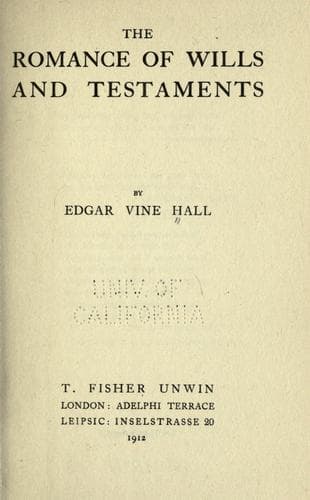
The Romance of Wills and TestamentsVine Hall, Edgar
History
The Romance of Wills and Testaments
Vine Hall, Edgar
Wills -- Great Britain -- Miscellanea
In “The Thunderbolt” the simple theme is drawn out with quiet but
subtle skill. An elder brother dies, rich and with one child only, a
natural daughter. The family, upon whom nature has showered neither
excellence nor wealth, assembles with all the gloom and all the
curiosity appropriate to the occasion. It appears that there is no will
forthcoming; the daughter therefore will have no share in the estate,
the brothers and a sister being entitled between them. But when all is
thought to be settled and safe, when each has devised a new scheme and
scale of life, a brother breaks in upon the smug conclave announcing
that there was a will, but that he had destroyed it. His story breaks
down, and the act is traced to his wife who nursed the deceased on
his death-bed, accidentally found the will, and after his death
deliberately destroyed it. The poor daughter finds that her father has
not forgotten her; the selfish family is thunderstruck. Such is the
character, and hence the name, of the play.
In Sir Arthur Pinero’s drama no lawsuit follows, all parties agreeing
in a compromise. But in real life probate actions are a rich source of
intimate dramas and revelations. From them innumerable details emerge:
threats and cajolery, rights and wrongs, loves and hates, stand out
with all their tender or terrible insistence. In fiction inevitably
they find a place. In “Mr. Meeson’s Will” Sir Henry Rider Haggard has
discovered an extraordinary theme, but he has not shown the art which
made the ordinary theme of “The Thunderbolt” a subtle and telling play.
Mr. Meeson is outraged by his nephew’s plain-speaking, which reminds
him of his unrighteous dealings, and in a rage cuts him out of his
will. The girl on whose behalf the nephew was to be disinherited is,
by a strange course of events, thrown with Mr. Meeson on a deserted
island, with two sailors and a child only besides. In terror of death,
which swiftly overtakes him, Mr. Meeson would revive his former will,
but there is nothing with or upon which to write it. The only possible
method is to tattoo the dying man’s desires upon human flesh, and this
is done by one of the sailors upon the back of the tortured girl. She
is rescued by a passing ship; and on returning home a probate action,
such as never yet had been, was fought out to a triumphant conclusion.
Public-domain text, read in full here on John Shaqi.
Reviews
Reviews
No reviews yet
Be the first to share your thoughts on this work.
Join the Discussion
Join the discussion
Sign in to leave a comment or review.
Sign InorCreate an account