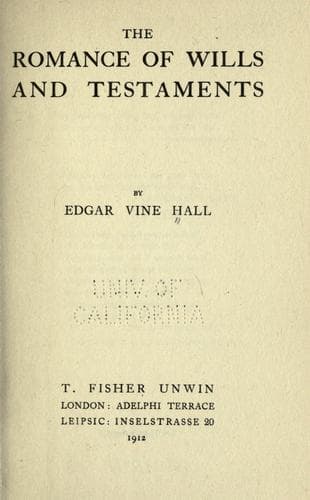
The Romance of Wills and TestamentsVine Hall, Edgar
History
The Romance of Wills and Testaments
Vine Hall, Edgar
Wills -- Great Britain -- Miscellanea
For nearly two hundred years a quaint custom has marked February 2nd
at Wotton, in Surrey, in pursuance of the will of William Glanvill.
Boys of twelve to sixteen stand bareheaded round the testator’s tomb,
recite the Lord’s Prayer, the Ten Commandments, and the Apostles’
Creed, read the 15th chapter of the First Epistle to the Corinthians,
and write down two verses therefrom. After these tests five boys are
selected, and receive 40s. apiece. As an instance of a school founded
by a will, John Neville, Lord Latimer (1542), may be quoted. “After my
decease the Master and Vicar (of Well, in Yorkshire) shall take all the
rents of the parsonage of Saint George Church in York, for the term of
forty years, and therewith to find a schoolmaster at Well for keeping a
school and teaching of grammar there, and to pray for me and them that
I am most bounden to pray for.” The school exists, but does the master
pray for the worthy founder still?
There are various reasons why wills should sometimes not be fulfilled.
The estate, for instance, may not be adequate. It is strange how vague
are the ideas of some testators in this respect, and one recalls
what Dr. Johnson said of a certain bequest to erect a hospital for
“ancient maids” that the word _maintain_ should be expunged and
_starve_ inserted, so insufficient were the funds. It is amusing (to
the outsider) when legacies are given with effusive expressions of
admiration or gratitude, while all the time there is no money to pay
them.
Some admit frankly that they have no material blessings to bestow.
Thomas Johnson, otherwise John Plummer (proved January 22, 1780),
left everything to his “dearly beloved and most deservedly esteemed
ever loving affectionate friend Ann Watson ... being thoroughly
sure she will take good care of the dear boy, J. H. Plummer, to
whom unfortunately I have nothing to leave but the wide world to
seek his fortune, excepting my prayers for his success.” Queen
Elizabeth Woodville, in her will dated April 10, 1492—a death-bed
will—pathetically says: “Whereas I have no worldly goods to do the
Queen’s Grace, my dearest daughter, a pleasure with, neither to reward
any of my children, according to my heart and mind, I beseech Almighty
God to bless her Grace, with all her noble issue; and with as good
heart and mind as is to me possible, I give her Grace my blessing, and
all the aforesaid my children.” _Maeonides nullas ipse reliquit opes._
Even Homer died penniless.
Public-domain text, read in full here on John Shaqi.
Reviews
Reviews
No reviews yet
Be the first to share your thoughts on this work.
Join the Discussion
Join the discussion
Sign in to leave a comment or review.
Sign InorCreate an account