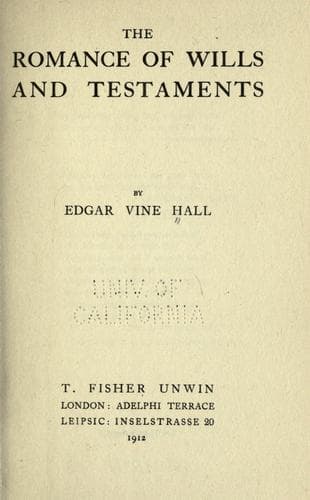
The Romance of Wills and TestamentsVine Hall, Edgar
History
The Romance of Wills and Testaments
Vine Hall, Edgar
Wills -- Great Britain -- Miscellanea
We are sometimes surprised, considering their characters, with the
lack of this or that feature in the wills of well-known men; but it
would, indeed, have been a surprise and a disappointment if Alexander
Cruden, the writer of the famous “Concordance,” had not expressed in
his will something, at least, of his doctrinal views and pious soul.
Written with his own hand, and signed and sealed at Aberdeen, April 10,
1770, his will thus begins: “In the name of God, Amen. I Alexander
Cruden, late a citizen and stationer of London, now living at Aberdeen,
being through the goodness of God sound in body and mind, do make and
ordain this to be my last will and testament. I acknowledge that I am
a miserable sinner by nature and life, being descended from the first
Adam, who by his fall in sinning against God hath involved himself and
his posterity in sin and misery. And I desire grace at all times, by
a true and saving faith, to look for redemption and salvation through
the blood and righteousness of our Lord Jesus Christ, the second Adam
and God Man Mediator, who by His wonderful incarnation obedience and
death hath satisfied divine justice, and purchased salvation for all
who are enabled truly to believe in this all sufficient and suitable
Saviour, and to receive Him as their Prophet Priest and King, and to
rest and rely upon Christ and His Righteousness alone for pardon and
eternal Salvation. And I desire that my body may be decently buried in
the Church yard of Aberdeen, where my pious father and his family are
interred.”
These are elaborate instances of piety in the eighteenth century; short
and general phrases as “I resign my soul into the hands of my Almighty
Creator, in the hopes of a glorious resurrection through the merits and
mediation of His blessed Son Jesus Christ, our Saviour and Redeemer,”
contained in the will of John Pybus (1789), are frequently to be found.
More uncommon is the confession of George Baker (1770), considering
the usual tone of contrition and penitence in wills. “In the Name of
the Eternal and Everlasting God the great Creator and Disposer of all
things, Whose divine law has been my study and His sacred paths my
supreme delight, I George Baker, of the Inner Temple, London, Esquire,
do make this my last will and testament.”
Public-domain text, read in full here on John Shaqi.
Reviews
Reviews
No reviews yet
Be the first to share your thoughts on this work.
Elsewhere in the archive
Join the Discussion
Join the discussion
Sign in to leave a comment or review.
Sign InorCreate an account