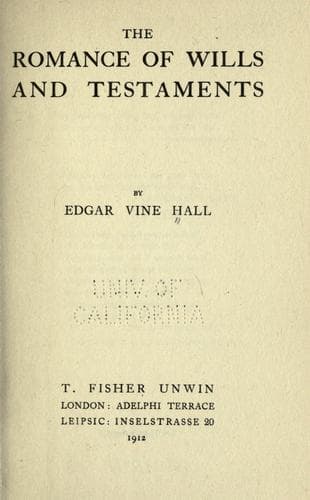
The Romance of Wills and TestamentsVine Hall, Edgar
History
The Romance of Wills and Testaments
Vine Hall, Edgar
Wills -- Great Britain -- Miscellanea
In Mrs. Gaskell’s “Sylvia’s Lovers” is the following passage: “Has
thee put that I’m in my sound mind and seven senses? Then make the
sign of the Trinity, and write ‘In the name of the Father, the Son,
and the Holy Ghost.’” “Is that the right way o’ beginning a will?”
said Coulson, a little startled. “My father and my father’s father,
and my husband had it atop of theirs, and I’m noane going for to cease
fra’ following after them, for they were godly men, though my husband
were o’ t’ episcopal persuasion.” It would be necessary to remember
how largely tradition and custom count, if we were to examine wills
carefully and thoroughly for the purpose of studying the piety of this
or that period of English life. Yet it can be seen how valuable these
prefaces are. Elaborate or simple, there is much to learn and mark in
them. But it is curious to observe that George Herbert (to leave the
eighteenth century for a moment), and William Law, two of the most
pious souls of their periods, use very few words in their religious
dedications. The first says simply: “I George Herbert, recommending
my soul and body to Almighty God that made them, do thus dispose of
my goods.” William Law, in terms only a little more elaborate, thus
begins: “I William Law, of Kings Cliffe, in the County of Northampton,
Clerk, being I bless God in good health of body and soundness of mind,
do make this my last will and testament in manner and form following,
that is to say: Imprimis: I humbly recommend my soul to the mercies of
God in Christ Jesus, and my body I commit to the earth to be interred
in the Church yard of Kings Cliffe aforesaid, at the discretion of my
executrix.”
CHAPTER VIII
THE DEAD HAND
“With this thread from out the tomb my dead hand
shall tether thee!”
FRANCIS THOMPSON.
John Oliver Hobbes, in “The Dream and the Business,” makes Firmalden’s
uncle leave to him £5,000 a year, on condition that he should become
and remain a Congregational minister. “My uncle meant well by his
will,” Firmalden said, “but I must have my independence. That money
binds me hand and foot. I have no rage against wealth as wealth. I like
it. But I must either earn it or inherit it unconditionally.”
In “Maid’s Money” Mrs. Dudeney makes “old Aunt Eliza” leave to Amy and
Sarah, cousins, her wealth and her house in Cornwall on the condition
that they always live there together and unmarried. “Listen!” says
Diana to David in Mrs. Barclay’s “The Following of the Star.” “There
was a codicil to Uncle Falcon’s will—a private codicil known only to
Mr. Inglestry and myself, and only to be made known a year after his
death, to those whom, if I failed to fulfil its conditions, it might
then concern. Riverscourt, and all this wealth, are mine, only on
condition that I am married within twelve months of Uncle Falcon’s
death. He has been dead eleven.”
Public-domain text, read in full here on John Shaqi.
Reviews
Reviews
No reviews yet
Be the first to share your thoughts on this work.
Elsewhere in the archive
Join the Discussion
Join the discussion
Sign in to leave a comment or review.
Sign InorCreate an account