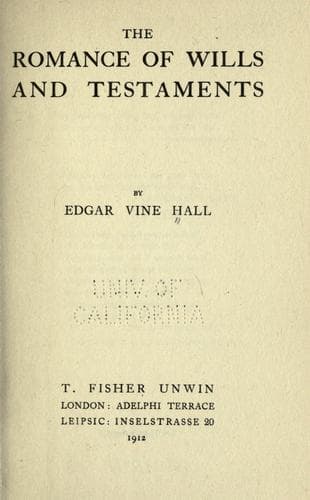
The Romance of Wills and TestamentsVine Hall, Edgar
History
The Romance of Wills and Testaments
Vine Hall, Edgar
Wills -- Great Britain -- Miscellanea
Mrs. Craigie’s, Mrs. Dudeney’s, and Mrs. Barclay’s imaginary wills
are no less binding and coercive than many real wills seek to be.
Conditional legacies are indeed become a byword, and are often of a
difficult, not to say preposterous, nature.
G. K. Chesterton in “Orthodoxy” has a fanciful but suggestive passage,
in which he conceives of life itself as so strange a legacy that man
must not gape or wonder if the conditions too are strange. “If I leave
a man in my will ten talking elephants and a hundred winged horses, he
cannot complain if the conditions partake of the slight eccentricity
of the gift. He must not look a winged horse in the mouth.” Legally,
it may be of interest to note in passing, a devise of property on an
impossible condition will not take effect. If a man is to inherit lands
on condition that he goes from Britain to Rome in an hour, he will not
(until flying-machines are more perfect) ever succeed to the lands.
Such provisions are stock material in the drama, from Shakespeare to
“The New Sin.” “So is the will of a living daughter curbed by the will
of a dead father,” sighs Portia in “The Merchant of Venice.” Lesser
comedy and melodrama are much indebted to conditional wills. To take
two recent examples: In “The Pin and the Pudding” the rich uncle of the
poor hero Malkin leaves him his riches—on condition that he has never
been in prison: whereby hangs the tale. In “The Beggar Girl’s Wedding”
Jack Cunningham only inherits his father’s fortune if he is married by
the time he is twenty-five: whence a thrilling plot develops.
But to study real life. A legacy of £20,000 was left recently by a
father to a son if, within ten years of the testator’s death, he should
have returned to the religious faith in which he was brought up. The
difference between the two sects appeared to be slight, but the legacy
was under such conditions intolerable. Another strange distinction or
definition is that of “member of the Anglican Catholic Church,” as
opposed to “member of the Evangelical Protestant Church”: but recently
a testator stipulated that no one should take a benefit who deserved
the former appellation.
Public-domain text, read in full here on John Shaqi.
Reviews
Reviews
No reviews yet
Be the first to share your thoughts on this work.
Elsewhere in the archive
Join the Discussion
Join the discussion
Sign in to leave a comment or review.
Sign InorCreate an account