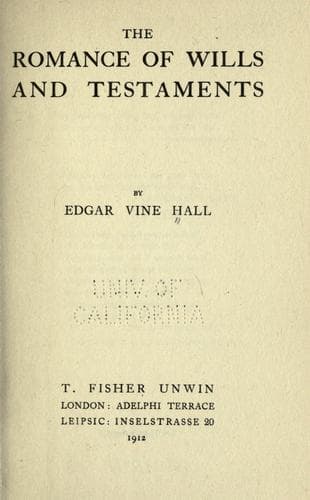
The Romance of Wills and TestamentsVine Hall, Edgar
History
The Romance of Wills and Testaments
Vine Hall, Edgar
Wills -- Great Britain -- Miscellanea
More intelligible is the distinction between Roman Catholicism and
Protestantism, and in this respect the dead hand is apt to lay heavy
restrictions on the living. That any legatee becoming a Roman Catholic
or marrying a Roman Catholic shall forfeit all interest is a common
provision: it has even been stipulated that if a daughter’s husband
should become a Roman Catholic she herself should forfeit. More
comprehensive was the will of a testator who cut down the benefit
of any child who should join the Roman Catholic Church, or become
associated with the Peculiar People, Faith Healers, or Christian
Scientists or any similar religious or quasi-religious body, he
“well knowing the harm, trouble and misery caused in homes thereby.”
Comprehensive, too, was the will of a minister who recorded his
“detestation of all state establishments of religion, believing them to
be anti-scriptural and soul-ruining. I have for years prayed the King
of Zion to overthrow the politico-ecclesiastical establishment of the
British Empire, and I leave the world with a full conviction that such
prayer must ere long be answered. I thirst to see the Church brought
down, the Church by man set up, for millions are by it led on to drink
a bitter cup.... Heaven dash all error sin and the devil from the
earth, and cause truth holiness and Christ everywhere to prevail.”
It is strange that any should think it a moral act to strive to bind
and bribe the consciences of their children or heirs. It is pleasant
to turn to the story of Henry More’s inheritance, where tolerance was
shown in an intolerant age. The Calvinism of his parents could not
appeal to the dreamy, intellectual youth, and they perceived how he was
drifting away from their manners and beliefs. But it is said that his
father seeing him one day among his books at Cambridge—not Calvinistic,
we may be sure—was so taken by his looks and manner that he went away
and set him down for a substantial legacy in his will.
But not only in religion the effort to shape destinies is shown.
Legacies are made conditional, for instance, on the recipient
remaining single, on not marrying a person named, or one not approved
by the testator’s wife and sister-in-law, a first cousin, an Irishman.
An American heiress ten years of age was to forfeit the fortune of her
grandmother if she travelled unaccompanied by a maid or chaperon of
education and refinement, or if she married a divorced man or an actor.
Recently a legacy was left on condition that the donee should marry a
lady in society.
Public-domain text, read in full here on John Shaqi.
Reviews
Reviews
No reviews yet
Be the first to share your thoughts on this work.
Elsewhere in the archive
Join the Discussion
Join the discussion
Sign in to leave a comment or review.
Sign InorCreate an account