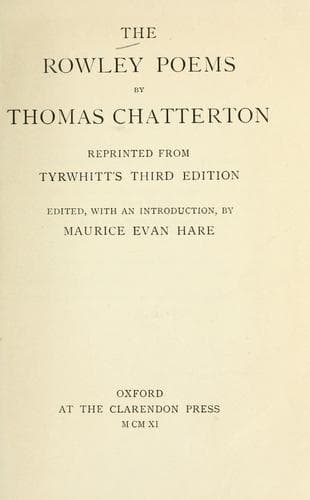
English poetry -- 18th century; Literary forgeries and mystifications -- Early works to 1800
Depycte wyth skylled honde upponn thie wyde _aumere_.
And eke the grounde was dighte in its mose deste _aumere_.
Wythe gelten _aumeres_ stronge ontolde.
The only place in which I remember to have met with this word is in
Chaucer's Romant of the Rose, ver. 2271. and there it undoubtedly
signifies _a purse_; probably from the Fr. _Aumoniere. Aumere of silk_
is Chaucer's translation of _Bourse de foye_. In another place of
the same poem, ver. 2087. he uses _aumener_ in the same sense. The
interpretations given of this word by Chatterton will be considered
below.
8. BARBED. Æ 27. 219.
Nott, whan from the _barbed_ horse, &c.
Mie lord fadre's _barbde_ halle han ne wynnynge.
Let it be allowed, that _barbed horse_ was a proper expression, in the
XV Century, for _a horse covered with armour_, can any one conceive
that _barbed hall_ signified _a hall in which armour was hung_? or
what other sense can _barbde_ have in this passage?
9. BLAKE. Æ 178. 407.
Whanne Autumpne _blake_ and sonne-brente doe appere.
_Blake_ stondeth future doome, and joie doth mee alyse.
_Blake_, in old English, may signifie either _black_, or _bleak_.
Chatterton, in both these passages, renders it _naked_; and, in the
latter, some such signification seems absolutely necessary to make any
sense.
10. BODYKIN. Æ 265.
And for a _bodykin_ a _swarthe_ obteyne.
_Bodekin_ is used by Chaucer more than once to signifie a _bodkin_ or
_dagger_. I know not that it had any other signification in his time.
_Swarthe_, used as a noun, has no sense that I am acquainted with.
11. BORDEL. E. III. 2.--Æ 147. BORDELIER. Æ 410.
Goe serche the logges and _bordels_ of the hynde.
We wylle in a _bordelle_ lyve.
Hailie the robber and the _bordelyer_.
Though _bordel_, in very old French, signifies a _cottage_, and
_bordelier_ a _cottager_, Chaucer uses the first word in no other
sense than that of _brothel_ or _bawdy-house_; and _bordeller_ with
him means the keeper of such a house. After this usage of these words
was so established, it is not easy to believe that any later writer
would hazard them in their primitive sense.
12. BYSMARE. M. 95.
Roaringe and rolleyng on yn course _bysmare_.
_Bismare_, in Chaucer, signifies _abusive speech_; nor do I believe
that it ever had any other signification.
13. CHAMPYON, V. PG. 12.
Wee better for to doe do _champyon_ anie onne.
I do not believe that _champion_ was used as a verb by any writer much
earlier than Shakespeare.
14. CONTAKE. T. 87. CONTEKE. E. II. 10.
----I _contake_ thie waie.
_Conteke_ the dynnynge ayre and reche the skies.
_Conteke_ is used by Chaucer, as a _noun_, for _Contention_. I know no
instance of its being used as a _verb_.
15. DERNE. Æ 582. DERNIE. E. I. 19. El. 8. M. 106.
Whan thou didst boaste soe moche of actyon _derne_.
Oh Raufe, comme lyste and hear mie _dernie_ tale.
O gentle Juga, beare mie _dernie_ plainte.
He wrythde arounde yn drearie _dernie_ payne.
Public-domain text, read in full here on John Shaqi.
Reviews
Reviews
No reviews yet
Be the first to share your thoughts on this work.
Elsewhere in the archive
Join the Discussion
Join the discussion
Sign in to leave a comment or review.
Sign InorCreate an account