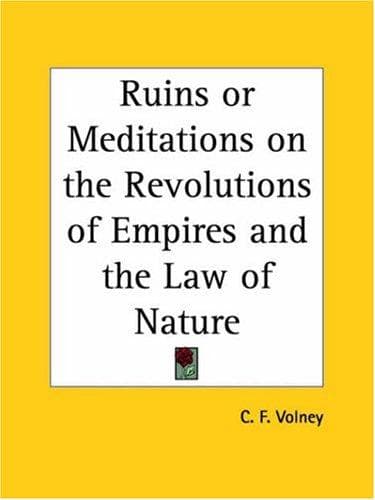
The Ruins; Or, Meditation on the Revolutions of Empires and the Law of Nature — John Shaqi
The Ruins; Or, Meditation on the Revolutions of Empires and the Law of NatureVolney, C.-F. (Constantin-François)
Religion
The Ruins; Or, Meditation on the Revolutions of Empires and the Law of Nature
Volney, C.-F. (Constantin-François)
Ethics; History -- Philosophy; Religions; Revolutions
When the hidden power which animates the universe, formed the globe
which man inhabits, he implanted in the beings composing it, essential
properties which became the law of their individual motion, the bond of
their reciprocal relations, the cause of the harmony of the whole; he
thereby established a regular order of causes and effects, of principles
and consequences, which, under an appearance of chance, governs the
universe, and maintains the equilibrium of the world. Thus, he gave to
fire, motion and activity; to air, elasticity; weight and density to
matter; he made air lighter than water, metal heavier than earth, wood
less cohesive than steel; he decreed flame to ascend, stones to fall,
plants to vegetate; to man, who was to be exposed to the action of so
many different beings, and still to preserve his frail life, he gave
the faculty of sensation. By this faculty all action hurtful to his
existence gives him a feeling of pain and evil, and all which is
salutary, of pleasure and happiness. By these sensations, man, sometimes
averted from that which wounds his senses, sometimes allured towards
that which soothes them, has been obliged to cherish and preserve his
own life; thus, self-love, the desire of happiness, aversion to
pain, become the essential and primary laws imposed on man by nature
herself--the laws which the directing power, whatever it be, has
established for his government--and which laws, like those of motion in
the physical world, are the simple and fruitful principle of whatever
happens in the moral world.
Such, then, is the condition of man: on one side, exposed to the action
of the elements which surround him, he is subject to many inevitable
evils; and if, in this decree, nature has been severe, on the other
hand, just and even indulgent she has not only tempered the evils with
equivalent good, she has also enabled him to increase the good and
alleviate the evil. She seems to say:
"Feeble work of my hands, I owe thee nothing, and I give thee life; the
world wherein I placed thee was not made for thee, yet I give thee the
use of it; thou wilt find in it a mixture of good and evil; it is for
thee to distinguish them; for thee to guide thy footsteps in a path
containing thorns as well as roses. Be the arbiter of thine own fate; I
put thy destiny into thine own hands!"
Yes, man is made the architect of his own destiny; he, himself, hath
been the cause of the successes or reverses of his own fortune; and if,
on a review of all the pains with which he has tormented his own
life, he finds reason to weep over his own weakness or imprudence
yet, considering the beginnings from which he sat out, and the height
attained, he has, perhaps, still reason to presume on his strength, and
to pride himself on his genius.
CHAPTER VI.
THE PRIMITIVE STATE OF MAN.
Public-domain text, read in full here on John Shaqi.
Reviews
Reviews
No reviews yet
Be the first to share your thoughts on this work.
Join the Discussion
Join the discussion
Sign in to leave a comment or review.
Sign InorCreate an account