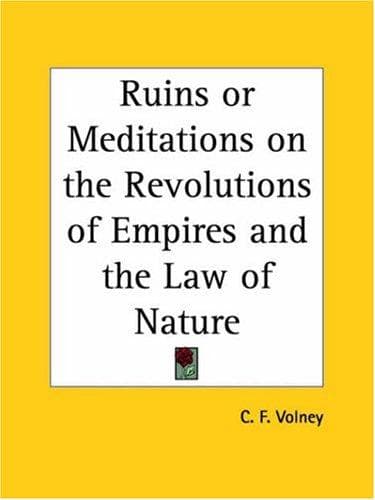
The Ruins; Or, Meditation on the Revolutions of Empires and the Law of NatureVolney, C.-F. (Constantin-François)
Religion
The Ruins; Or, Meditation on the Revolutions of Empires and the Law of Nature
Volney, C.-F. (Constantin-François)
Ethics; History -- Philosophy; Religions; Revolutions
Formed naked in body and in mind, man at first found himself thrown, as
it were by chance, on a rough and savage land: an orphan, abandoned by
the unknown power which had produced him, he saw not by his side beings
descended from heaven to warn him of those wants which arise only from
his senses, nor to instruct him in those duties which spring only
from his wants. Like to other animals, without experience of the past,
without foresight of the future, he wandered in the bosom of the forest,
guided only and governed by the affections of his nature. By the pain of
hunger, he was led to seek food and provide for his subsistence; by the
inclemency of the air, he was urged to cover his body, and he made him
clothes; by the attraction of a powerful pleasure, he approached a being
like himself, and he perpetuated his kind.
Thus the impressions which he received from every object, awakening his
faculties, developed by degrees his understanding, and began to instruct
his profound ignorance: his wants excited industry, dangers formed his
courage; he learned to distinguish useful from noxious plants, to
combat the elements, to seize his prey, to defend his life; and thus he
alleviated its miseries.
Thus self-love, aversion to pain, the desire of happiness, were the
simple and powerful excitements which drew man from the savage and
barbarous condition in which nature had placed him. And now, when his
life is replete with enjoyments, when he may count each day by the
comforts it brings, he may applaud himself and say:
"It is I who have produced the comforts which surround me; it is I who
am the author of my own happiness; a safe dwelling, convenient clothing,
abundant and wholesome nourishment, smiling fields, fertile hills,
populous empires, all is my work; without me this earth, given up
to disorder, would have been but a filthy fen, a wild wood, a dreary
desert."
Yes, creative man, receive my homage! Thou hast measured the span of the
heavens, calculated the volume of the stars, arrested the lightning in
its clouds, subdued seas and storms, subjected all the elements. Ah! how
are so many sublime energies allied to so many errors?
CHAPTER VII.
PRINCIPLES OF SOCIETY.
Wandering in the woods and on the banks of rivers in pursuit of game and
fish, the first men, beset with dangers, assailed by enemies, tormented
by hunger, by reptiles, by ravenous beasts, felt their own individual
weakness; and, urged by a common need of safety, and a reciprocal
sentiment of like evils, they united their resources and their strength;
and when one incurred a danger, many aided and succored him; when
one wanted subsistence, another shared his food with him. Thus men
associated to secure their existence, to augment their powers, to
protect their enjoyments; and self-love thus became the principle of
society.
Public-domain text, read in full here on John Shaqi.
Reviews
Reviews
No reviews yet
Be the first to share your thoughts on this work.
Join the Discussion
Join the discussion
Sign in to leave a comment or review.
Sign InorCreate an account