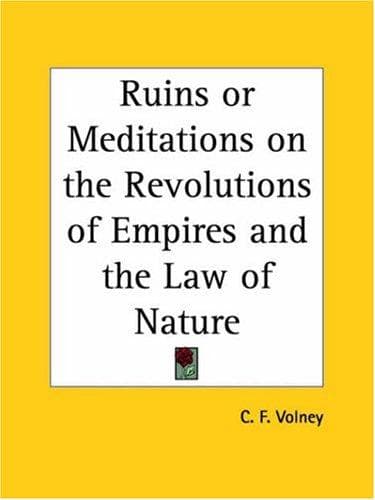
The Ruins; Or, Meditation on the Revolutions of Empires and the Law of Nature — John Shaqi
The Ruins; Or, Meditation on the Revolutions of Empires and the Law of NatureVolney, C.-F. (Constantin-François)
Religion
The Ruins; Or, Meditation on the Revolutions of Empires and the Law of Nature
Volney, C.-F. (Constantin-François)
Ethics; History -- Philosophy; Religions; Revolutions
The modern Aderbidjan, which was a part of Medea, the mountains of
Koulderstan, and those of Diarbekr, abound with subterranean canals, by
means of which the ancient inhabitants conveyed water to their parched
soil in order to fertilize it. It was regarded as a meritorious act
and a religious duty prescribed by Zoroaster, who, instead of preaching
celibacy, mortifications, and other pretended virtues of the monkish
sort, repeats continually in the passages that are preserved respecting
him in the Sad-der and the Zend-avesta:
"That the action most pleasing to God is to plough and cultivate the
earth, to water it with running streams, to multiply vegetation and
living beings, to have numerous flocks, young and fruitful virgins, a
multitude of children," etc., etc.
Among the aqueducts of Palmyra it appears certain, that, besides those
which conducted water from the neighboring hills, there was one which
brought it even from the mountains of Syria. It is to be traced a long
way into the Desert where it escapes our search by going under ground.
Thus ancient states prospered, because their social institutions
conformed to the true laws of nature; and because men, enjoying liberty
and security for their persons and their property, might display all the
extent of their faculties,--all the energies of their self-love.
CHAPTER XI.
GENERAL CAUSES OF THE REVOLUTIONS AND RUIN OF ANCIENT STATES.
Cupidity had nevertheless excited among men a constant and universal
conflict, which incessantly prompting individuals and societies to
reciprocal invasions, occasioned successive revolutions, and returning
agitations.
And first, in the savage and barbarous state of the first men, this
audacious and fierce cupidity produced rapine, violence, and murder, and
retarded for a long time the progress of civilization.
When afterwards societies began to be formed, the effect of bad habits,
communicated to laws and governments, corrupted their institutions and
objects, and established arbitrary and factitious rights, which depraved
the ideas of justice, and the morality of the people.
Thus one man being stronger than another, their inequality--an accident
of nature--was taken for her law;* and the strong being able to take
the life of the weak, and yet sparing him, arrogated over his person an
abusive right of property; and the slavery of individuals prepared the
way for the slavery of nations.
Public-domain text, read in full here on John Shaqi.
Reviews
Reviews
No reviews yet
Be the first to share your thoughts on this work.
Join the Discussion
Join the discussion
Sign in to leave a comment or review.
Sign InorCreate an account