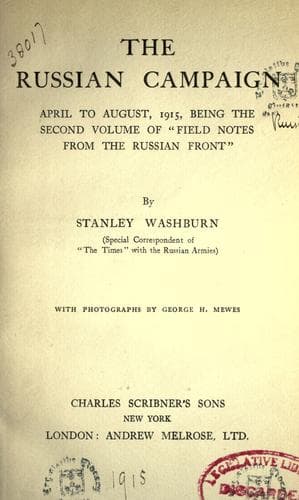
The Russian Campaign, April to August, 1915: Being the Second Volume of "Field Notes from the Russian Front" — John Shaqi
The Russian Campaign, April to August, 1915: Being the Second Volume of "Field Notes from the Russian Front"Washburn, Stanley
History
The Russian Campaign, April to August, 1915: Being the Second Volume of "Field Notes from the Russian Front"
Washburn, Stanley
World War, 1914-1918 -- Campaigns -- Eastern Front; World War, 1914-1918 -- Personal narratives
The strategic value of Przemysl itself was in no way acutely delaying
the Russian campaigns elsewhere, and they could afford to let the
Austrian General who shut himself and a huge army up in Przemysl, play
their own game for them, which is exactly what happened. There was no
such situation here as at Port Arthur, where the menace of a fleet in
being locked up in the harbour necessitated the capture of the Far
Eastern stronghold before the Russian second fleet could appear on the
scene and join forces with it. Nor was there even any such important
factor as that which confronted the Germans at Liège. To the amateur it
seems then that the Austrians, with eyes open, isolated a force which
at the start must have numbered nearly four army corps, in a position
upon which their programme was not dependent, and under conditions
which made its eventual capture a matter of absolute certainty
providing only that the siege was not relieved from without by their
own armies from the South.
The lesson of Przemysl may be a very instructive one in future wars.
The friends of General Sukomlinoff, the Russian Minister of War, are
claiming with some reason that what has happened here is a vindication
of the Minister’s theory, that fortresses in positions which are not
of absolute necessity to the military situation should never be built
at all, or should be abandoned at the inception of war rather than
defended unwisely and at great cost. It is claimed that if the Warsaw
forts had not been scrapped some years ago, the Russian Army to-day
would be standing a siege, or at least a partial siege, within the
city, rather than fighting on a line of battle 40 kilometres to the
west of it. Port Arthur is perhaps an excellent example of the menace
of a fortified position of great strength. So much had been done to
make that citadel impregnable that the Russians never dreamed of giving
it up. The result was that a position, which was doomed to succumb
eventually, was made the centre of all the Russian strategy. For months
the army in the North was forced to make attempt after attempt to
relieve the position, with the results that they lost probably four
times the number of the garrison in futile efforts to relieve it. A
fortress which has cost large sums of money must be defended at any
cost to justify the country that has incurred the expense. Forces
which can probably be ill spared from field operations are locked up
for the purpose of protecting expensive works which, as in the case of
Przemysl, yield them little or nothing but the ultimate collapse of
their defence, and the consequent demoralization of the field armies
which have come to attach an importance to the fortress which, from a
strategic point of view, it probably never possessed.
V
Public-domain text, read in full here on John Shaqi.
Reviews
Reviews
No reviews yet
Be the first to share your thoughts on this work.
Join the Discussion
Join the discussion
Sign in to leave a comment or review.
Sign InorCreate an account